
Mobile App Development Cost Breakdown 2026: Where Does Your Money Go?
Product development
Updated: October 6, 2026 | Published: January 25, 2026
Key Takeaways
Cost for mobile app development ranges by complexity: Simple apps cost $10,000-$50,000, while enterprise-grade apps reach $150,000-$500,000+
Mobile app development budget allocation: Development takes 40-55% of your budget, followed by design (15-25%), QA (10-15%), and discovery (10-15%)
Cross-platform mobile apps save money: Using Flutter or React Native instead of native development cuts costs by 30-50%
Hidden costs are significant: Plan for 15-25% of the initial cost annually for maintenance, plus hosting, API fees, and App Store charges
Location of mobile app developers matters: US developers charge $100-300/hour vs. $30-80/hour in Eastern Europe for comparable quality
MVP-first approach: Starting with a minimum viable product can reduce initial investment by up to 60%
The mobile app market is projected to reach $330 billion in 2026, and if you're reading this, you're probably trying to figure out how much of that you need to spend.
Here's what most founders experience: You have an app idea. You reach out to a few agencies. You get quotes ranging from $30,000 to $250,000 for what sounds like the same thing. Nobody explains why the numbers are so different, and you're left wondering who's overcharging and who's cutting corners.
We get it. Before you can choose a development partner, you need to understand what you're actually paying for.
This guide provides a complete software development cost breakdown–stage by stage, feature by feature–so you can evaluate quotes with confidence, ask the right questions, and avoid the budget surprises that derail projects.
Quick Cost Estimates
Before diving into the details, here's a snapshot of what mobile app development costs look like in 2026:
App Complexity | Cost Range | Timeline |
|---|---|---|
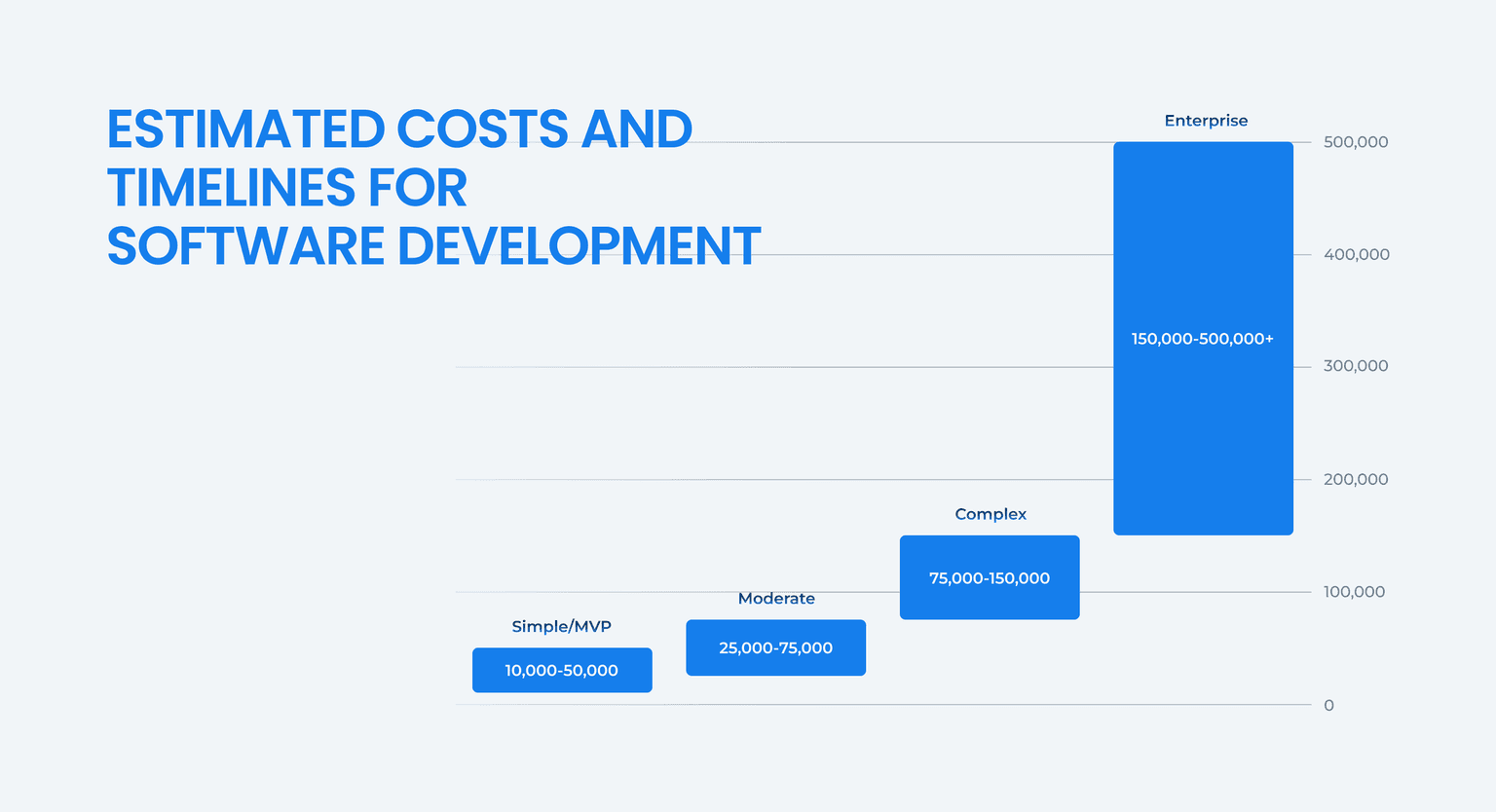
Simple/MVP | $10,000-$50,000 | 2-4 months |
Moderate | $25,000-$75,000 | 4-7 months |
Complex | $75,000-$150,000 | 7-12 months |
Enterprise-grade | $150,000-$500,000+ | 9-18+ months |
According to Business of Apps, the average cost for a funded startup building a v1 mobile app in the US or EU falls between $80,000 and $250,000. The wide range reflects differences in complexity, platform choices, and team location.
Is Your Budget Realistic?
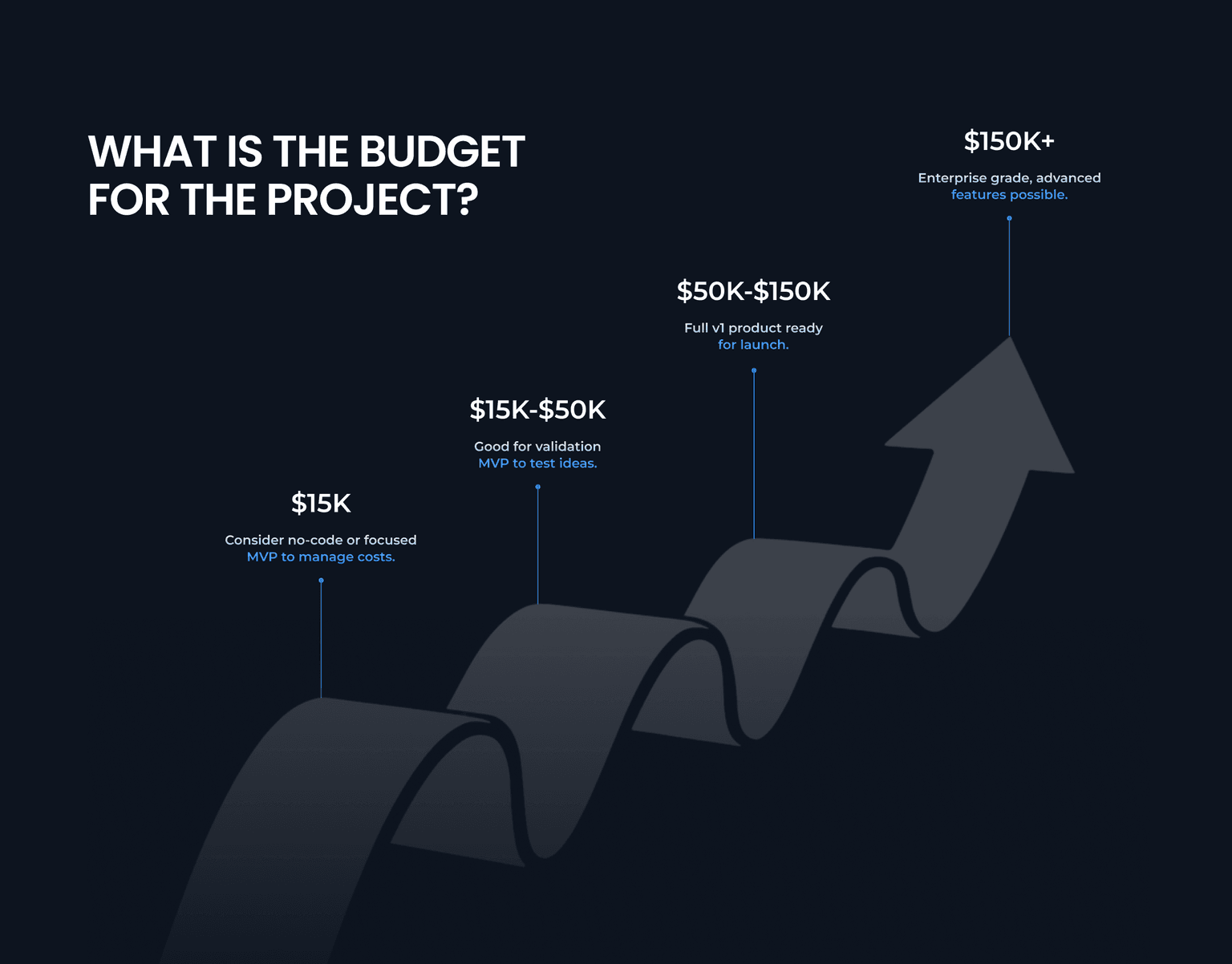
Before diving deeper, here's a quick reality check based on your available budget:
Your Budget | Realistic Goal | Recommendation |
|---|---|---|
Under $15,000 | Basic MVP with 3-5 core features, single platform | Consider no-code tools (Bubble, FlutterFlow) or a very focused MVP |
$15,000-$50,000 | Functional MVP with custom backend, one platform or cross-platform | Good starting point for validation; plan for post-launch iteration budget |
$50,000-$150,000 | Full-featured app, cross-platform, custom design, integrations | Solid budget for a v1 product ready for market |
$150,000+ | Complex app with advanced features (AI, real-time, compliance) | Enterprise-grade builds, multiple user types, scalable architecture |
Honest advice: If your budget is under $25,000 and your feature list has 15+ items, something has to give. Either reduce the scope, extend the timeline, or increase the budget. Agencies that promise everything for less are likely cutting corners or planning to hit you with change orders later.
Comprehensive App Development Cost Breakdown by Stages
Understanding how app development cost distributes across different stages helps you budget more accurately. The mobile app development process follows predictable phases, each consuming a specific portion of your total investment.
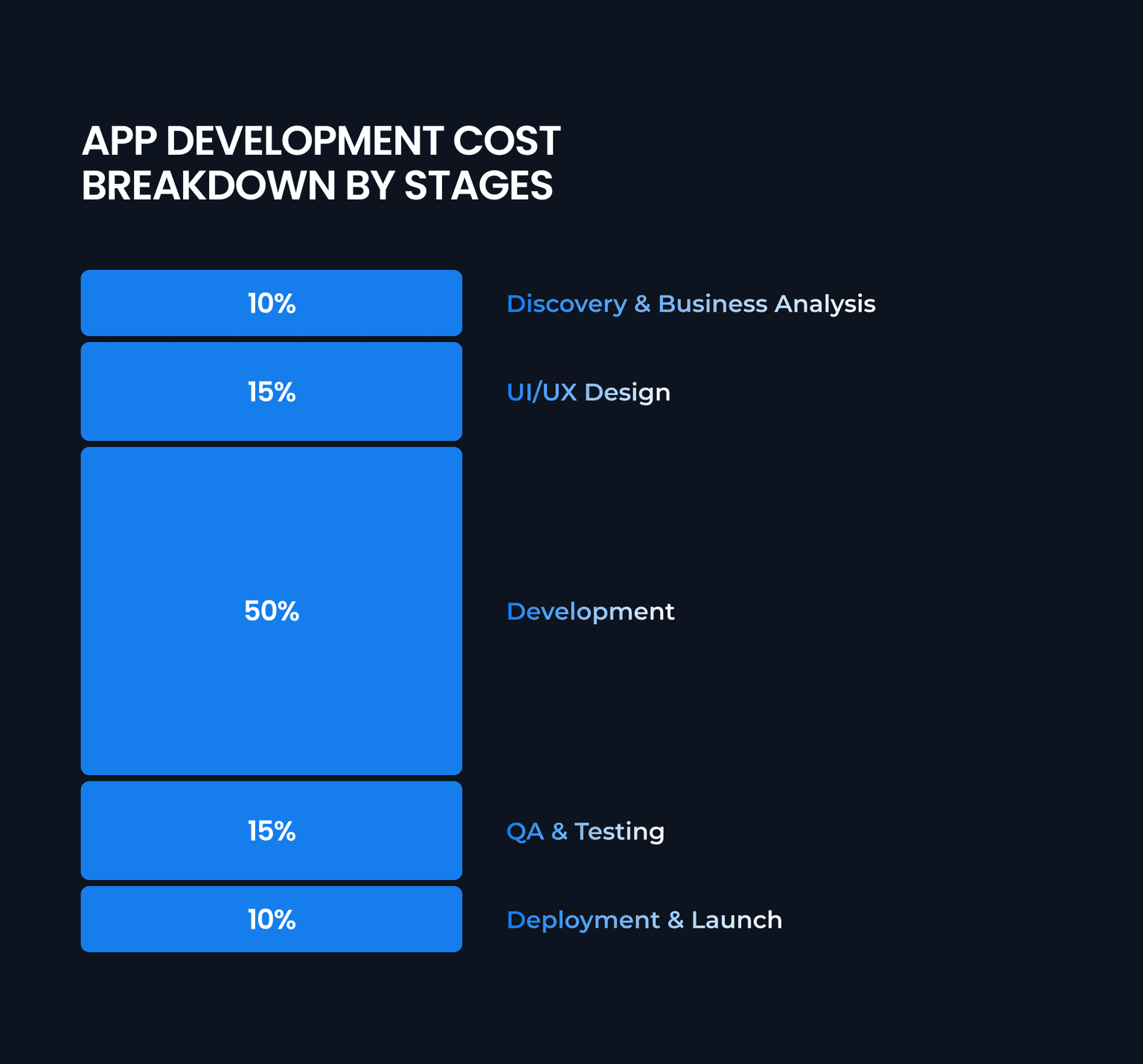
Here's how a typical app development budget breaks down:
Stage | % of Budget | Cost Range | You'll Get |
|---|---|---|---|
Discovery & Business Analysis | 10-15% | $4,000-$15,000 | Market research, specifications, user personas, technical requirements |
UI/UX Design | 15-25% | $5,000-$50,000 | Wireframes, prototypes, design system, user testing |
Development (Backend + Frontend) | 40-55% | $30,000-$150,000+ | Coding, architecture, API development, database setup |
QA & Testing | 10-15% | $5,000-$50,000 | Manual testing, automated testing, security audits, bug fixes |
Deployment & Launch | ~10% | Variable | App Store submission, cloud setup, analytics integration |
Why Each Stage Matters
Discovery & Business Analysis (10-15%): This phase sets the foundation. Institutional research from McKinsey and PMI indicates that nearly half of project failures stem from poor requirements. By investing 10-15% in a Discovery phase, it is possible to align with industry leaders like IBM, who demonstrate that identifying logic flaws now is 100 times more cost-effective than fixing them after launch
UI/UX Design (15-25%): Design isn't just aesthetics – it's functionality. A well-designed app reduces development time by providing clear specifications and reduces post-launch costs by minimizing user friction.
Development (40-55%): This is where most of your app development cost goes. The development stage includes frontend coding (what users see), backend development (servers, databases, APIs), and integration work. Complex features like AI, real-time functionality, or third-party integrations increase this percentage significantly.
QA & Testing (10-15%): Cutting corners on testing guarantees higher costs later. Fixing bugs in production costs five times more than catching them during development.
Case Example: Scalable Mobile Architecture
A German property management platform needed one app that could be rebranded for each of its clients, without rebuilding from scratch every time. DBB Software designed a modular React Native architecture with dynamic theming and automated deployment pipelines.
The result: new branded app versions now launch in days instead of months, dramatically reducing per-client costs and time-to-market.
Get a Scope First, and Then Get Accurate Cost Estimates.
Vague briefs lead to inflated quotes. Generate a free project scope document with our AI before requesting any proposals.
Generate My Free Scope
Key Factors Affecting Mobile App Development Costs
Beyond the stage-by-stage breakdown, several factors significantly affect app development cost. Understanding these key app development cost drivers helps you make informed trade-offs.
1. App Complexity
The complexity of your app is the single biggest app development cost driver:
Complexity Level | Features | Cost Range |
|---|---|---|
Simple | Basic UI, limited features, no backend | $10,000-$25,000 |
Medium | Custom API, user authentication, forms, payments | $25,000-$75,000 |
Complex | Real-time features, third-party integrations, multi-platform | $75,000-$150,000 |
Enterprise | AI/ML, IoT integration, advanced security, compliance | $150,000-$500,000+ |
Feature-specific costs add up quickly:
AI/Machine Learning integration: $20,000-$100,000+
IoT connectivity: $25,000-$100,000+
E-commerce features: $15,000-$80,000+
Real-time chat/messaging: $15,000-$40,000
2. Platform Choice: Native vs. Cross-Platform
Your platform decision directly impacts total app development cost and timeline:
Approach | Cost Impact | Code Reuse | Best For |
|---|---|---|---|
Native (iOS + Android separately) | 2x development cost | 0% | Performance-critical apps, platform-specific features |
Cross-platform (Flutter/React Native) | 30-50% savings | 80-95% | Most business apps, faster time-to-market |
According to the Stack Overflow Developer Survey 2025, Flutter now holds 46% market share while React Native captures 35%, together dominating over 80% of cross-platform development. The survey notes that "the native vs cross-platform debate is effectively over for 90% of business use cases", as cross-platform apps are now indistinguishable from native apps to end users.
Case Example: Cross-Platform Efficiency
A Canadian smart textile company needed a mobile app that could read biometric data from their garments on both iOS and Android. Instead of building two separate apps, DBB Software used Flutter to create a single-codebase solution. The cross-platform approach cut development time significantly while still delivering real-time biometric data processing across both platforms.
3. Development Team Location
Where your development team is located dramatically affects hourly rates and total project cost:
Region | Hourly Rate | Cost Impact |
|---|---|---|
USA (Silicon Valley, NYC) | $100-$300/hr | Highest |
Western Europe (UK, Germany) | $60-$150/hr | High |
Eastern Europe (Ukraine, Poland) | $30-$80/hr | Moderate |
Latin America (Brazil, Argentina) | $25-$80/hr | Moderate |
India, Southeast Asia | $18-$40/hr | Lowest |
Outsourcing to Eastern Europe or Latin America can save 40-70% on labor costs while maintaining quality. The US Bureau of Labor Statistics reports US-based developers averaging $62-90/hour.
4. Customization Level
Standard UI components cost less than custom designs:
Template-based UI: Lower cost, faster development
Custom animations and interactions: Add 20-40% to design costs
Unique design system: Premium investment but stronger brand identity
How to Reduce App Development Cost Without Cutting Corners
Smart planning can significantly reduce your app development cost without sacrificing quality. Here are proven strategies to reduce software development costs:
1. Start with an MVP
An MVP (Minimum Viable Product) lets you validate your app idea before committing full resources. An MVP-first approach can save up to 60% compared to building a full-featured app from the start.
Typical MVP cost: $20,000-$70,000
Case Example: MVP-First Approach
When launching the Choo Choo transportation app, the founders worked with DBB Software to build a focused MVP first. By validating the core concept with real users before investing in advanced features, they avoided building functionality nobody wanted—and kept their initial investment lean while proving market demand.
2. Choose Cross-Platform Development
Using Flutter or React Native instead of building separate native apps delivers:
30-50% cost reduction
Single codebase for iOS and Android
One team instead of two
Unified maintenance and updates
3. Invest in the Discovery Phase
According to Fortune Business Insights data on successful app launches, thorough discovery prevents costly mid-development changes. Teams that invest adequately in requirements gathering avoid the scope creep that inflates budgets by 30-50%.
4. Leverage Third-Party Services
Building everything custom is expensive. Using established services saves significant development time:
Integration | Build Custom | Use Third-Party | Savings |
|---|---|---|---|
Authentication | $15,000-25,000 | Auth0/Firebase | $5,000-15,000 |
Payments | $20,000-40,000 | Stripe/PayPal | $10,000-30,000 |
Communication | $10,000-20,000 | Twilio/SendGrid | $3,000-10,000 |
5. Partner with the Right Development Team
The cheapest option isn't always the most cost-effective when evaluating app development cost. Consider:
Eastern European teams: $25-50/hour with strong technical education and English proficiency
Transparent pricing: Agencies that provide itemized quotes help you understand exactly what you're paying for
Pre-built solutions: Teams with existing code libraries and frameworks can accelerate development by 30-50%
What to Budget Beyond Development
The app launch is just the beginning. According to DesignRush research, post-launch costs often exceed initial development investment over the app's lifetime, but spread across 3-5+ years, these costs are predictable and manageable with proper planning. Here's what to plan for:
Annual Maintenance Costs
Industry standard is 15-25% of initial development cost annually:
Maintenance Type | Cost | Frequency |
|---|---|---|
General maintenance | 15-25% of initial cost | Annual |
First-year maintenance | Up to 50% of initial cost | Year 1 |
OS compatibility updates | ~$10,000 | Annual (iOS/Android releases) |
Bug fixes and patches | 2-5% of build cost | Monthly |
Infrastructure and Hosting
Your app needs servers, databases, and cloud services:
Service | Monthly Cost |
|---|---|
Basic cloud hosting (AWS/Azure) | $70-$320 |
Moderate traffic app | $300-$1,500 |
High-traffic enterprise app | $1,500-$5,000+ |
Both AWS and Microsoft Azure offer 40-70% discounts with 1-3 year commitments.
Third-Party Services
Many apps rely on paid APIs and services:
Google Maps API: Pay-as-you-go with volume discounts
Payment processing (Stripe): Per-transaction fees
SMS/Communication (Twilio): Usage-based pricing
Analytics platforms: $0-500+/month
App Store Fees
Don't forget the gatekeepers:
Platform | Registration | Annual Fee | Commission |
|---|---|---|---|
Apple App Store | — | $99/year | 15-30% |
Google Play | $25 one-time | None | 15-30% |
According to SplitMetrics, the 15% reduced rate applies to developers earning under $1 million annually (Apple) or on the first $1 million (Google).
Key insight: If you budget only for the build and not the first 12-18 months after launch, every surprise will feel like budget overrun rather than normal operating costs.
Mobile App Development Cost Calculator: Estimate Your Project
While online mobile app development cost calculator tools can give you a rough starting point, the most accurate app development cost estimate comes from understanding your specific scenario. Instead of guessing hours, find the scenario closest to your app, which will help you decide what mobile app development services you may need:
Scenario A: "I need a simple app for my existing business"
Customer-facing app with login, content, notifications
Connects to your existing website/backend
Single platform or cross-platform
Estimate: $25,000-$50,000
Scenario B: "I'm building an MVP to test a new idea"
3-5 core features that prove the concept
User accounts, basic functionality, simple backend
Needs to look professional but not pixel-perfect
Estimate: $40,000-$80,000
Scenario C: "I need a marketplace or platform connecting two user types"
Buyer/seller, driver/rider, provider/customer
Payments, messaging, ratings, search
Admin dashboard to manage the platform
Estimate: $80,000-$180,000
Scenario D: "I'm building a complex product with advanced features"
AI/ML, real-time collaboration, IoT, video
Compliance requirements (healthcare, finance)
Multiple user roles with different permissions
Estimate: $150,000-$400,000+
Real-World App Cost Examples
How much did famous apps cost to build?
App | Original Cost | Rebuild Estimate |
|---|---|---|
Instagram (2010) | $500,000 initial funding | $50,000-$500,000 |
Uber (2011) | $1-1.5 million MVP | $40,000-$300,000+ |
Airbnb | Started with simple website | $40,000-$300,000 |
For specific app types in 2026:
App Type | Core Features | Estimated Cost |
|---|---|---|
Social Media App | Feed, profiles, messaging, media sharing | $50,000-$300,000 |
E-commerce App | Catalog, cart, payments, order tracking | $30,000-$300,000 |
On-demand Service (Uber-like) | Maps, matching algorithm, payments, ratings | $40,000-$300,000 |
Healthcare App | Patient portal, scheduling, records, compliance | $50,000-$500,000 |
Important caveat: Mobile app development cost calculators are guides, not guarantees. They don't account for scope creep, unique requirements, or whether your app idea is commercially viable.
How to Evaluate Vendor Quotes
When you receive quotes from development agencies, use this framework to compare them fairly:
What a Good Quote Should Include
Itemized breakdown by phase (discovery, design, development, QA)
Hour estimates per feature or module
Hourly rate clearly stated
Assumptions about what's included and excluded
Change request process and pricing
Timeline with milestones
Payment schedule tied to deliverables
Red Flags to Watch For
Red Flag | Why a Problem |
|---|---|
Single lump-sum price with no breakdown | You can't verify what you're paying for |
Significantly lower than other quotes (30%+) | They may be underscoping or planning to upsell |
No discovery phase included | They're guessing at requirements |
"Unlimited revisions" promises | Unsustainable; expect pushback later |
Vague timeline ("4-6 months") | Lack of planning; expect delays |
No mention of testing/QA | Budget for bugs in production |
Questions to Ask Every Vendor
"Can you walk me through how you arrived at this estimate?"
"What's included in the hourly rate? Just development, or PM and QA too?"
"What happens if we need to change a feature mid-project?"
"How do you handle scope creep?"
"What does your discovery/planning phase include?"
"Can I see a similar project you've completed with the actual timeline and process?"
Comparing Apples to Apples
When comparing quotes, normalize them:
Vendor | Quote | Hours | Effective Rate | Discovery? | QA? |
|---|---|---|---|---|---|
A | $80,000 | 1,000 | $80/hr | Yes | Yes |
B | $60,000 | 800 | $75/hr | No (+$8K) | Minimal |
C | $95,000 | 1,200 | $79/hr | Yes | Yes |
In this example, Vendor B's "lower" quote actually costs $8,000+ more when you add the missing discovery phase and proper QA, turning a $60K quote into $68K+ with gaps that could cause problems later.
Your Next Steps
Now that you understand app development cost factors and have tools to estimate your project, here's how to move forward:
If you're still exploring (budget TBD):
List your must-have features vs. nice-to-haves
Identify which scenario above fits your app
Decide: MVP first, or full product?
If you're ready to get quotes:
Prepare a one-page brief (problem, users, key features)
Reach out to 3-4 agencies in your target price range
Use the "Evaluating Quotes" framework above to compare
Ask for references from similar projects
If you have a quote and aren't sure:
Check if it includes all phases (discovery, design, dev, QA)
Ask for an itemized breakdown
Compare the effective hourly rate to market rates
Request a 30-minute call to walk through assumptions
The most successful apps aren't the most expensive ones. They're built by founders who understood their costs, asked the right questions, and chose partners who were honest about trade-offs.
Teams that invest in pre-development planning are 3x more likely to succeed.
Our Scope Document ($777) delivers a complete discovery package, Technical Audit, Product Requirements, Engineering Design, and UI/UX Review, so you can approach vendors with clarity and confidence.
Contact Us

FAQ



Fullstack .NET / C# Developer
Most Popular