Developing a Rail-Ticketing Platform for a Startup
DBB Software built a mobile-first rail-ticketing platform in a 12-week MVP, then kept building it into a live product selling tickets on web, iOS and Android. It has taken more than £300,000 in ticket sales across four months and serves more than 10,000 active users drawn from over 100 countries.
Industry
Travel & Hospitality
Service
Mobile App Development
Team
1 Project Manager, 1 Mobile Developer, 2 Back-End Developers, 1 QA Engineer
Project State
March 2025 - Ongoing
Country

United Kingdom

About the Client
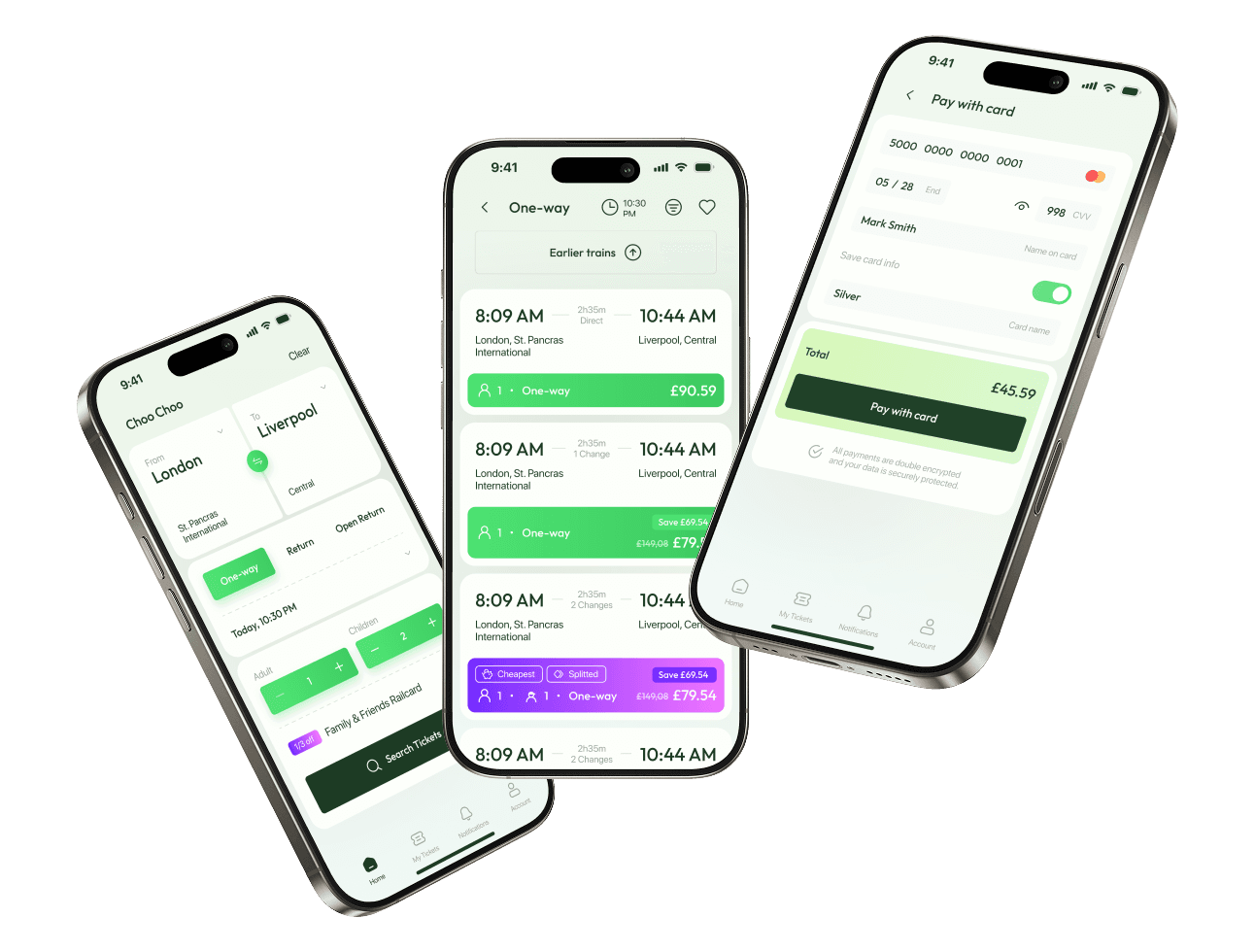
The client is a UK startup selling train tickets direct to travelers. Their product sets out to give passengers a clearer alternative to established rail-ticketing services, through a shorter booking flow, transparent pricing and an interface built for a phone first. The company sells on the national network as a retailer, and competes on how quickly a traveler can find the right ticket at the lowest available fare.

The Client's Initial Request
The client required a platform to sell railway tickets with future bus ticket expansion, aiming to outshine competitors’ complex UX and hidden fees.
Minimal Engineering Overhead
Optimize the project's cost and stay lean without compromising the quality of the MVP.
01
Fast Time-to-Market
Deliver a mobile-first MVP within 12 weeks, enabling the startup to compete quickly and validate product-market fit before burning runway.
02
Presentation-Ready Demonstration
Assist the founder in securing partnerships to strengthen the long-term development of the solution through a presentable working prototype.
03
User-Friendly UI
Create a user-friendly interface for searching, purchasing, and managing tickets, including support for discounts and railcards.
04
Quality-of-Life Features
Add features for real-time updates, the most affordable ticket options, and streamlined delay-repay processes to differentiate from the competition.
05
Solutions We Delivered
DBB Software delivered a comprehensive suite of tailored services to bring the client’s rail-ticketing vision to life.
Scope Document
Four discovery sprints produced a 12-week delivery plan for a mobile-first app, with a roadmap that mapped long-term collaboration and left room for later expansion into bus ticketing.
Starting From Pre-Built Solutions
DBB's own pre-built solutions stood up the mobile app foundation in 6 hours and the backend backbone in 2 hours, both by a single developer. The saved weeks went into product features.
The Ticketing Backend
A NestJS service organized by business domain: 22 feature modules and 18 controllers exposing 83 HTTP handlers, each module holding its own service and repository layer.
Ticket inventory, fares and ticket issuing are reached through an accredited industry retail API, held behind a single integration service so the rest of the platform never couples to it directly.
13 scheduled jobs keep station, railcard and operator reference data current, and drive notification delivery.
Firebase Authentication is the single source of user identity across web, iOS and Android, covering email, Google, Apple and anonymous sign-in.
Payment runs client-side through Stripe, so card data never touches DBB's backend.
The Booking Flow End to End
A traveler searches, selects, pays and receives a ticket without leaving the flow.
Journey search returns results enriched with station names, live status and cheapest or fastest labels.
Checkout supports card payment alongside Apple Pay and Google Pay, with seat reservation attempted and a fallback path when the reservation cannot be held.
Tickets arrive as e-tickets with QR validation, downloadable PDFs and wallet passes, and remain viewable with the network switched off.
Guest checkout lets someone buy without an account, and their bookings attach to a profile if they create one later.
Split-Ticket Savings
The platform surfaces cheaper combinations of tickets covering the same seats on the same trains, and records the saving it found for each purchase, so the benefit is measurable.
Real-Time Travel Information
The platform holds a direct connection to the rail industry's real-time feed, Darwin, over a streaming message channel rather than polling for updates.
Delays, cancellations and platform changes reach a traveler through 7 notification types covering departures, arrivals and service status.
Live status appears in search results, so a journey already running late is visible before it is bought.
Delay Compensation Across the Network
Compensation entitlement is modeled as data rather than coded per operator. Schemes carry their own compensation tiers, and operators point at the scheme they run, which covers 29 operators across four delay bands and three ticket types without a special case for each one.
Gated Delivery and On-Call
A pre-release gate of 19 checks covers formatting, linting, a full monorepo build, unit, integration and end-to-end tests, an automated code review and a test-coverage floor of 80 percent.
Regression is risk-scoped: 23 feature areas are each marked changed, smoke-only or full before a release, across a 28-section suite spanning iOS, Android, tablets, foldables and web.
Hotfix branches are cut from the production tag rather than from main, which keeps a fix clear of unreleased work.
High-risk features deploy behind feature gates and are enabled gradually. A critical release issue is met by redeploying the previous tag, against a 15-minute restore target.
Out of hours, alerting routes by time of day through four defined bands, with retry intervals and an escalation path to a second responder and then to a manager.
Results Achieved

Over £300,000 processed
Ticket sales processed through the platform exceeded £300,000 across four months of active trading.

Over 10,000 active users
More than 10,000 people actively used the product across the most recent two-month period.

Demand from over 100 countries
Active users span more than 100 countries, expanding the platform's reach well beyond a domestic audience.

One day to a full-stack foundation
Pre-built solutions put the mobile and backend foundations in place in eight hours with one developer.

Early commercial partnership secured
Designs, wireframes, and a working prototype helped the founder secure Raileasy as an early commercial partner.

12 Weeks to MVP Launch
The mobile-first MVP reached both iOS and Android precisely on the founder's go-to-market timeline.
Want to Bring Your Idea to Life with a Market-Ready MVP?
Book a call with our Business Development Advisor to receive a consultation on realizing your MVP idea.
Contact Us
"Most of our work starts with a 30-minute call where someone describes a product they're trying to ship and one part of the engineering picture they can't get around.
If that's where you are, let's set one up; I'll tell you straight whether we're the right fit.”

Mina Morkos
Business Development Manager


Want a similar outcome for your team?
Ask our AI assistant — it can pull related case studies, talk through the approach, and put you in touch with the team if you want a deeper conversation.