
MVP Development Team Structure in 2026: Roles, Cost, and Hiring Guide
MVP
Product development
Updated: May 7, 2026 | Published: January 16, 2025

Building an MVP is not about assembling the largest possible team. It is about forming the right team structure at the right stage to validate ideas quickly, control costs, and prepare the product for future growth.
In this guide, we break down how an MVP development team should be structured in 2026, how team size evolves from pre-seed to Series A, and what founders should realistically expect in terms of roles and responsibilities.
Ideal MVP Team Structure for Startups (By Stage)
The optimal MVP development team structure depends heavily on the startup’s funding stage, technical complexity, and business goals. Early-stage teams should stay lean, while later stages require more specialization and process maturity.
Below is a practical breakdown of MVP team composition by startup stage.
Pre-Seed Stage: The “Hacker” Duo (2-3 People)
At the pre-seed stage, the primary goal is idea validation, not scalability. The team should be extremely lean, focused on speed and experimentation.
A typical pre-seed MVP team includes:
Founder / Product Owner – defines the vision, validates assumptions, and prioritizes features.
Technical Lead or Full-Stack Developer – builds the core MVP functionality end to end.
(Optional) UI/UX Designer – often part-time or contract-based, focused on basic usability.
At this stage, roles often overlap. One person may handle development, deployment, and basic QA. Dedicated project managers or DevOps engineers are usually unnecessary and would increase MVP development cost without proportional value.
Seed Stage: The Core Team (5-7 People)
Once initial traction or funding is secured, the focus shifts to stability, usability, and faster iteration. The MVP needs to support real users and collect reliable feedback.
A typical seed-stage MVP development team includes:
Product Owner – manages backlog and aligns development with business goals.
Project Manager – ensures delivery timelines, sprint planning, and communication.
2-3 Software Engineers – frontend, backend, or full-stack depending on product needs.
UI/UX Designer – improves user flows and product experience.
QA Engineer – ensures basic quality, regression testing, and release stability.
This structure balances speed and quality while keeping the team small enough to remain flexible.
Series A: The Scaling Squad (10+ People)
At Series A, the MVP often transitions into a production-ready product. Scalability, performance, and reliability become top priorities.
A Series A MVP team usually expands to include:
Multiple specialized engineers (frontend, backend, mobile).
Dedicated QA engineers for automation and testing coverage.
DevOps engineers to manage infrastructure, CI/CD, and cloud scalability.
Product and delivery roles focused on roadmap execution and metrics.
At this stage, the team structure becomes more formal, and processes like Agile, Scrum, and continuous delivery are critical to sustain growth.
Core Roles in an MVP Development Team
An effective MVP team requires a clear understanding of each member's role. That’s why you need to define the roles for your team members, so they know their responsibilities and minimize overlaps, enhancing cooperation.
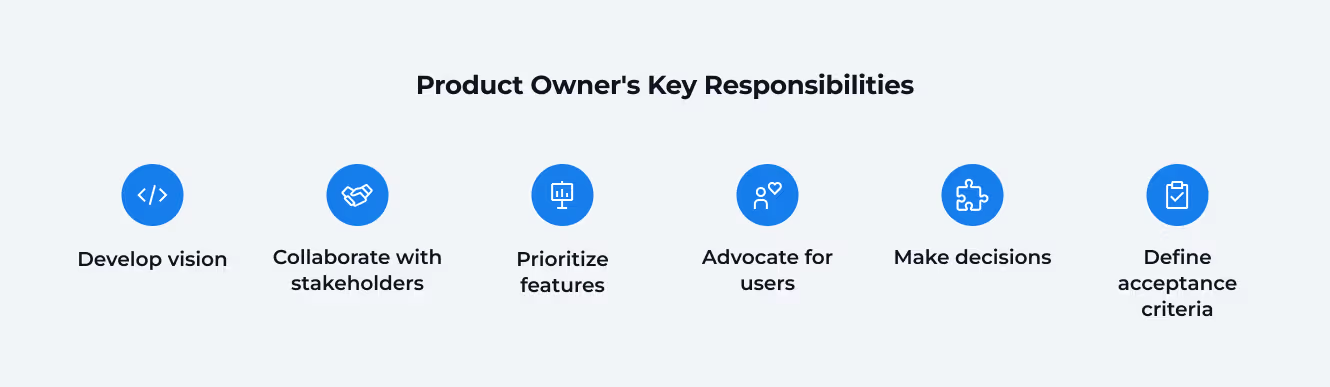
Product Owner
The PO is the key decision-maker for an MVP project. A good PO focuses on aligning the MVP with business objectives and user needs. This requires a clear vision of the product’s goals. They make strategic decisions that balance immediate needs with long-term objectives.
Let’s consider a scenario where a team has to develop a marketplace MVP. The PO might prioritize features like user registration and product listings while omitting complex additions like advanced analytics for later iterations. This adaptability to priorities based on received information ensures the product evolves effectively.
Project Manager (PM)
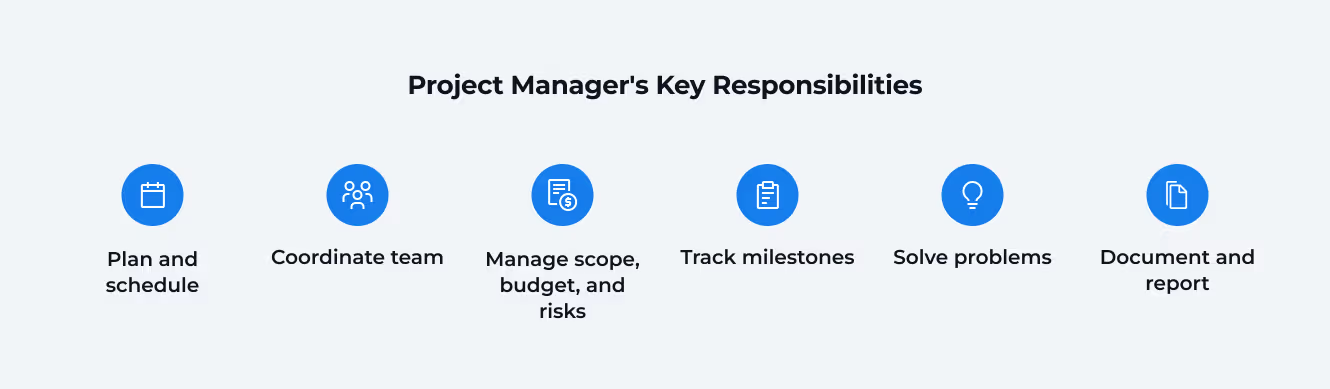
The PM is the backbone of the MVP development team. They act as a central hub, connecting team efforts with project goals while proactively addressing challenges to prevent disruptions.
A good PM might organize daily stand-ups and two-week sprints in a Scrum framework. Findings show that organizations prioritizing project management meet project objectives 92% of the time, compared to 32% for those that don't. This information easily outlines the importance of effective PMs for MVP projects.
Software Engineers (Frontend, Backend, Full-Stack)
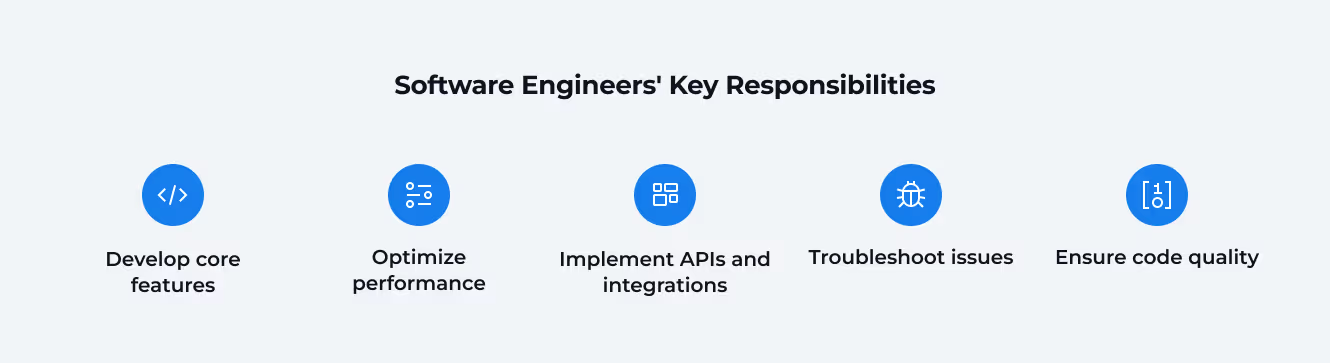
Frontend developers create the UI, focusing on making an intuitive and engaging UX. Backend developers manage server-side logic, database interactions, and app performance. Full-stack developers offer versatility in handling various development aspects by engaging in both domains.
For example, in an e-commerce MVP, backend engineers might integrate payment gateways, while frontend developers design a seamless shopping interface. Their combined efforts ensure the MVP operates effectively, providing users with a reliable and satisfying experience.
Quality Assurance (QA) Engineer
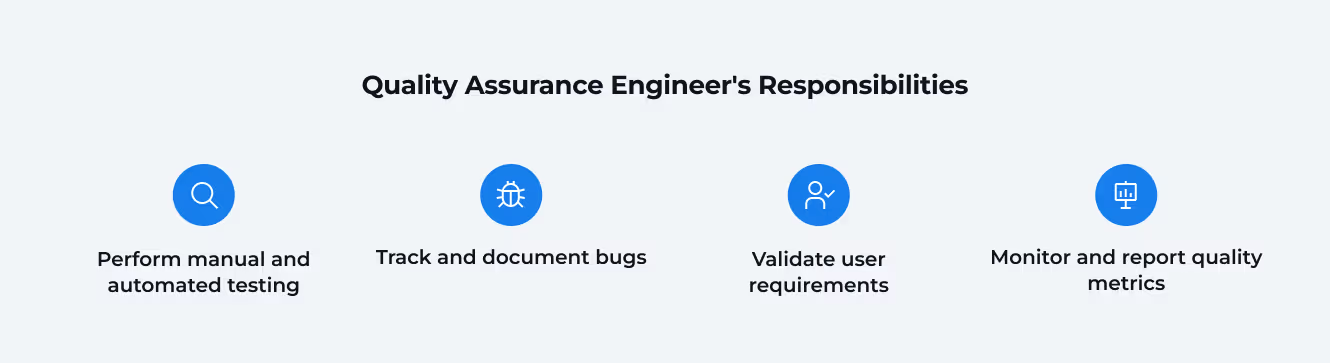
QA specialists’ work is about ensuring the product functions correctly and meets user expectations. They identify defects early and send this valuable feedback to developers to reduce the risk of launching an incomplete or imperfect solution.
A QA engineer might conduct usability testing to ensure an intuitive UX, which is crucial for user retention. Companies using QA metrics experience a 30% reduction in software defects, resulting in higher product quality and customer satisfaction. This is a clear indicator of the importance of the QA role in an MVP development team, where user acceptance is crucial.
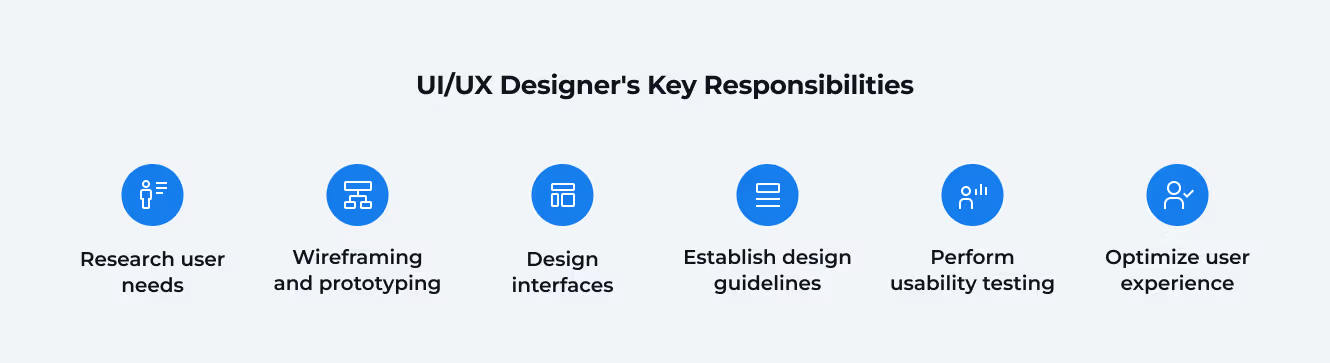
UI/UX Designer
The designer balances aesthetics and functionality to create an MVP's UX and visual appeal. These specialists translate user needs and business goals into designs that serve as a blueprint for the development team.
For example, a UI/UX Designer might streamline a mobile app’s onboarding process. This focus ensures users can easily navigate and complete key actions, which boosts user retention and satisfaction.
Do You Need DevOps or Data Analysts for an MVP?
In most cases, DevOps and Data Analysts are not mandatory at the early MVP stage. Their involvement depends on product complexity and business requirements.
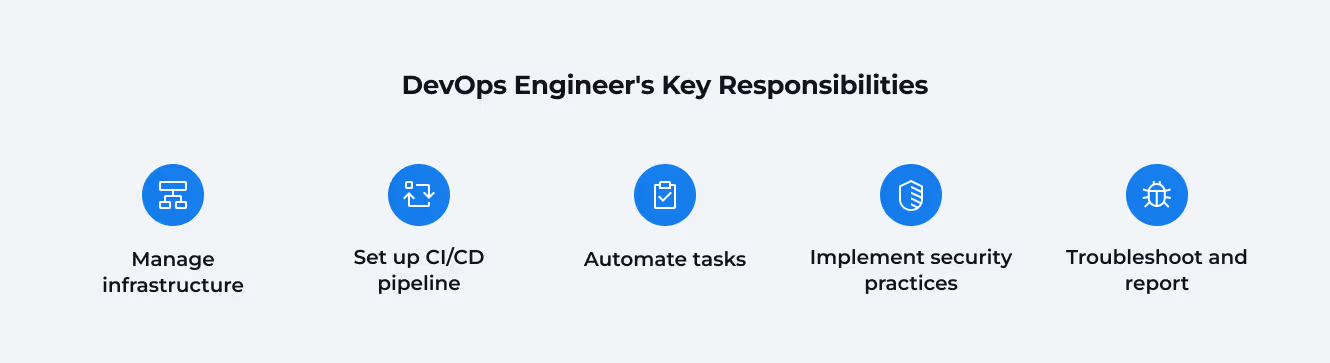
DevOps engineers become necessary if your MVP requires:
complex cloud infrastructure,
high availability from day one,
CI/CD pipelines or strict security controls.
For many MVPs, these responsibilities can be temporarily handled by a senior developer or an agency team.
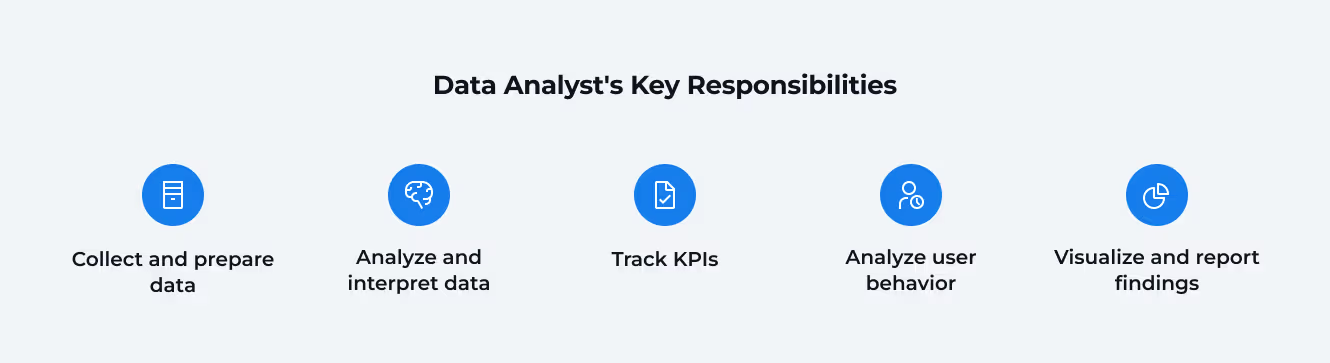
Data analysts are rarely required before product-market fit. At the MVP stage, basic analytics tools (Google Analytics, Mixpanel, Amplitude) are usually sufficient to validate assumptions.
Conclusion: For most startups, DevOps and data analytics are introduced after MVP validation, not during initial development.
How Much Does an MVP Team Cost? (2026 Rates)
One of the most common founder questions is MVP development cost. The total cost depends on team model, location, and duration.
Below is a practical comparison of typical 2026 rates.
Freelance vs. Agency vs. In-House Rates (2026)
Team Model | Average Hourly Rate | Monthly Cost (Small Team) | Best For |
|---|---|---|---|
Freelancers | $30–$70 | $6,000-$12,000 | Very early validation, tight budgets |
In-House Team | $60-$120 | $18,000-$30,000+ | Long-term products, funded startups |
Development Agency / Dedicated Team | $50-$100 | $12,000-$25,000 | MVPs with deadlines and quality requirements |
Agency and dedicated team models often include project management, QA, and delivery processes, which reduces hidden costs and risks.
Cost Calculation Example: 3-Month MVP Build
A typical 3-month MVP development project may include:
1 Product Owner (part-time)
2 Developers
1 UI/UX Designer (part-time)
1 QA Engineer (part-time)
Estimated cost range:
Freelancers: $25,000-$45,000
Dedicated development team: $40,000-$80,000
In-house team: $70,000-$120,000+ (including hiring and overhead)
This is the most common cost bracket founders should expect when planning an MVP in 2026.
Hiring Options: In-House vs. Freelancers vs. Dedicated Team
Choosing the right hiring model affects speed, risk, and long-term scalability.
Comparison: Pros, Cons & Time-to-Hire
Model | Pros | Cons | Time to Start |
|---|---|---|---|
In-House Team | Full control, long-term alignment | High cost, slow hiring, overhead | 2-4 months |
Freelancers | Low upfront cost, flexibility | Coordination risk, variable quality | 2-4 weeks |
Dedicated Team | Fast start, predictable delivery, built-in processes | Less internal control | 1-2 weeks |
Why Dedicated Teams are Best for MVPs
For most startups, a dedicated software development team is the most balanced option for MVP development.
Key reasons:
faster time-to-market compared to in-house hiring;
lower risk than managing multiple freelancers;
predictable MVP development cost;
access to ready-made processes (Agile, QA, delivery).
Dedicated teams allow founders to focus on validation and fundraising instead of operational complexity.
How to Hire an MVP Development Team: Step-by-Step
Hiring an MVP development team is not just a technical decision. It directly affects speed, budget control, and the startup’s ability to pivot early.
Below is a practical step-by-step approach founders can follow in 2026.
Define Your Tech Stack & Budget
Before engaging developers, founders should clearly define:
the core problem the MVP is solving;
must-have vs. nice-to-have features;
expected timeline for validation.
This clarity helps determine:
whether a simple or scalable architecture is required;
the appropriate tech stack (for example, web-first vs. mobile-first);
a realistic MVP development budget.
Without this step, teams risk overengineering or underestimating costs early on.
Screen for Startup Mindset (Not Just Code)
Technical skills alone are not enough for MVP development. Startups need teams that understand uncertainty, iteration, and fast decision-making.
When evaluating candidates or agencies, look for:
experience working with early-stage startups;
ability to challenge assumptions and propose alternatives;
comfort with incomplete requirements and rapid feedback cycles.
A strong startup mindset often matters more than deep specialization at the MVP stage.
Check MVP-Specific Case Studies
Not all development experience translates well to MVPs. Enterprise-only teams may struggle with speed and flexibility.
Focus on case studies that show:
MVPs built within 3-4 months;
rapid prototyping and iteration;
products that evolved after launch based on user feedback.
This reduces the risk of working with teams optimized for long-term delivery rather than early validation.
DBB Software Approach to MVP Teams
DBB Software approaches MVP development as a business validation process, not just a technical build. The company focuses on creating lean, scalable MVP teams that match the startup’s stage and goals.
Key principles of the DBB Software MVP approach include:
Stage-based team composition. Teams are assembled based on funding stage (pre-seed, seed, Series A), ensuring founders do not overpay for unnecessary roles early on.
Full-cycle MVP development services for startups. From discovery and architecture to development, QA, and post-launch support, DBB Software supports the entire MVP lifecycle.
Rapid prototyping with scalability in mind. MVPs are built quickly while laying the groundwork for future growth, avoiding costly rewrites after validation.
Strong focus on quality assurance and security. Even early-stage products follow secure development practices to ensure stability and data protection.
Transparent communication and delivery. Agile workflows, regular demos, and direct access to the team help founders stay aligned throughout development.
This approach allows startups to launch faster, control MVP development cost, and smoothly transition from validation to scaling without changing teams.
Team Management & Workflow Tips
Effective team management is critical for MVP success. At early stages, the goal is not process maturity but fast learning, clear ownership, and minimal overhead.
Agile & Scrum for MVPs
Agile and Scrum are well-suited for MVP development because they support short feedback loops and rapid iteration.
Best practices for MVP teams include:
short sprints (1–2 weeks) with clearly defined goals;
frequent demos to validate progress with stakeholders;
continuous backlog refinement based on user feedback.
For MVPs, Agile should remain lightweight. Overly rigid ceremonies or documentation can slow down experimentation and increase development cost without adding value.
Communication Tools (Slack, Jira, Linear)
Clear communication helps distributed MVP teams stay aligned and move fast.
Commonly used tools include:
Slack for real-time communication and quick decision-making;
Jira or Linear for backlog management, sprint planning, and issue tracking;
shared documentation tools for requirements, decisions, and user feedback.
The key is not the tools themselves, but transparency and regular communication that keeps everyone focused on MVP goals.
Conclusion
To build a successful MVP, assembling and managing the right development team is critical. By focusing on key roles, fostering collaboration, and implementing efficient workflows, you can navigate challenges and deliver a product that meets user needs and drives business value.
Whether creating your first MVP or scaling to the next stage, having an expert team makes all the difference. Need help assembling or managing your MVP team? Contact us for industry-leading expertise in MVP development and team management.
FAQ



Fullstack .NET / C# Developer
Most Popular