Building the Care-Request API Behind an AI Voice Intake Agent
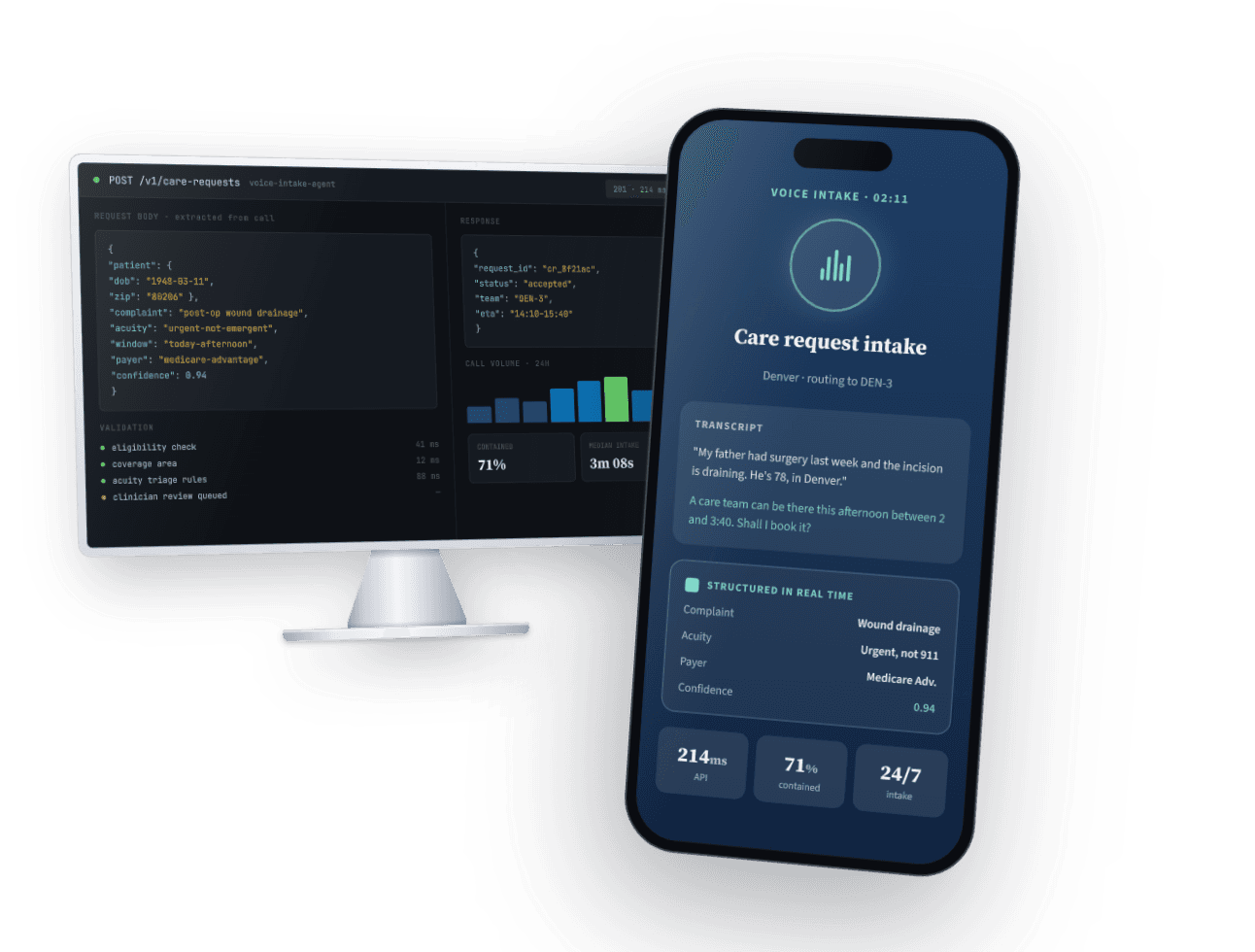
DBB Software built the API layer that lets a voice-AI agent take a patient call and turn it into a complete care request: demographics, insurance, risk assessment, and a scheduled visit, with no dispatcher in the loop. It runs in production, and the client's second IVR vendor is plugged into the same endpoints as the first.
Industry
Healthcare & Biotech
Service
Digital Transformation
Team
2 Back-End Engineers
Project State
Ongoing
Country

United States

About the Client
DispatchHealth delivers high-quality, on-demand urgent care directly to patients’ homes, giving patients an alternative to emergency rooms, urgent care clinics, and hospital visits. Their model reduces healthcare costs, increases convenience, and improves patient outcomes by bringing medical teams directly to where patients live.

The Client’s Initial Request
DispatchHealth engaged DBB Software to build the backend behind a new voice-AI intake agent. The client's own AI team built the conversational agent and the connector that drives it. DBB built the API it calls.
Visits Created Without a Dispatcher
A patient calling in should be able to create a real care request end-to-end, without a dispatcher taking the details by hand.
01
A Vendor Swap Without a Rebuild
The client was moving from one IVR vendor to another. The care-request layer underneath had to serve the new agent without being rebuilt for it.
02
Risk Stratification During the Call
The agent needed to retrieve the appropriate risk protocols based on the patient's description while the call was still open.
03
A Route Back to a Human
When a case requires secondary screening, the call must be routed back to a human agent on the contact-center platform.
04
Solutions we delivered
Two back-end engineers delivered the endpoint set in six weeks because DBB had already built the intake integration for the previous IVR vendor, and the care-request layer was designed to be called from outside.
One Endpoint Per Step of the Call
A single call walks the agent through the full care-request sequence, and each step is an API the agent calls in order:
Capture patient demographics
Capture insurance details
Create the visit as a care request
Retrieve risk protocols and record the risk assessment
Schedule the visit
By the time the call ends, the care request exists in the same system of record a dispatcher would have written to.
Risk Protocol Lookup From Complaint Keywords
The client's agent extracts keywords from what the patient says about their complaint and sends them to a DBB endpoint, which returns the matching risk protocols.
The lookup runs mid-call, so risk stratification happens while the patient is still on the line.
The clinical content stays on the client's side. DBB's endpoint serves the protocols; it does not decide what they mean.
Keeping the match on the keyword rather than the raw transcript keeps the request small and the response fast enough for a live conversation.
Authenticated Access From a Known Server
The caller into these endpoints is an MCP server the client's AI team built, running outside DBB's codebase. The API treats it as an external client rather than a trusted internal caller, and two controls gate it, both DBB's.
DBB provisioned and supplied the Auth0 credentials the server authenticates with.
DBB allowlisted the server's IP addresses on the API, so intake traffic is accepted from that one host and refused from anywhere else.
An Intake Layer the Vendor Plugs Into
The endpoints were not written for one voice vendor. They express the care-request workflow itself, which is why a second vendor could take over the conversation without the layer beneath it changing.
The previous IVR integration established the surface. The new agent consumed it.
Six weeks covered the endpoints the new workflow needed, rather than a rebuild of intake.
The client's AI team could iterate on the conversation independently, against an API contract that was already stable.
The Handoff Back to a Human
Not every call should finish with the agent. Where secondary screening is needed, the call transfers back to a human on the contact-center platform, and the care request captured so far persists rather than being restarted.
Results Achieved

Patients create a visit without a dispatcher
A call now produces a complete care request: demographics, insurance, risk assessment and a scheduled visit.

A second vendor onboarded onto the same contract
The new agent consumed the API the previous one had, so the system of record was untouched.

Six weeks with two back-end engineers
Prior work on the previous IVR integration meant most of the endpoint surface already existed.

Risk stratification inside the call
Complaint keywords return matching risk protocols while the patient is still on the line.

Escalation keeps the work already done
Secondary screening reaches a person on the contact-center platform without the patient repeating themselves.

Intake capacity that does not scale with headcount
Calls that once needed a dispatcher's time now reach the system of record on their own.
Put Your Backend Behind an AI Agent
DBB Software builds the API layer AI agents call, so the intelligence can change vendors without the system of record changing with it.
Contact Us
"Most of our work starts with a 30-minute call where someone describes a product they're trying to ship and one part of the engineering picture they can't get around.
If that's where you are, let's set one up; I'll tell you straight whether we're the right fit.”

Mina Morkos
Business Development Manager


Want a similar outcome for your team?
Ask our AI assistant — it can pull related case studies, talk through the approach, and put you in touch with the team if you want a deeper conversation.