
Flutter vs. Native in 2026: What CTOs Need to Know
Product development
Updated: June 26, 2026 | Published: January 28, 2026

Key Takeaways
By 2026, cross-platform mobile development has become the default choice for ~90% of business applications, with native reserved for niche, performance-critical use cases;
Flutter delivers near-native performance while reducing total development cost by 30–40% through a shared codebase and unified teams;
The historical performance gap between native vs Flutter is now marginal for most commercial apps and rarely perceived by end users;
Time-to-market and long-term TCO are the primary drivers behind the shift from native-only strategies to cross-platform architectures;
Maintaining one codebase instead of two significantly lowers maintenance cost, release risk, and operational overhead over a multi-year lifecycle;
Native development still makes sense for 3D-heavy, AR/VR, or hardware-intensive products, but no longer justifies its cost for standard business apps.
By 2026, cross-platform mobile development has moved from a tactical shortcut to a strategic default for many businesses. The traditional gap between native and cross-platform mobile apps has narrowed significantly due to improvements in tooling, performance engines, and ecosystem maturity.
For CTOs and technical decision-makers, the discussion is no longer theoretical. It directly affects time-to-market, development cost, long-term maintenance, and the ability to scale products across platforms without duplicating effort.
The core dilemma remains familiar:
Native mobile development promises maximum performance and deep platform integration.
Flutter and cross-platform development offer speed, cost efficiency, and a shared codebase.
In 2026, however, the trade-offs look very different than they did even three years ago.
Quick Comparison: Flutter vs. Native (2026 Snapshot)
Factor | Native | Flutter |
|---|---|---|
Performance | Slightly higher peak performance | Near-native for most use cases |
Development Cost | High (two teams, two codebases) | 30–40% lower on average |
Time-to-Market | Slower | Faster MVP and iteration cycles |
Developer Availability | Fragmented (Swift + Kotlin) | Larger unified talent pool |
This comparison frames the strategic question CTOs face today: Is native still worth the additional cost and complexity for most business applications?
The State of Mobile App Development in 2026
The mobile app development landscape in 2026 is defined by consolidation and pragmatism. Businesses are under pressure to deliver faster, iterate more often, and manage total cost of ownership over a longer product lifecycle.
Several trends shape the current state of mobile app development frameworks:
Rapid growth of cross-platform mobile apps in B2B and consumer products;
Increased expectations for consistent UX across platforms;
Stronger tooling around testing, CI/CD, and performance monitoring;
AI-driven features becoming a baseline requirement rather than a differentiator.
Modern mobile app development services have evolved to support these demands. Flutter, React Native, and similar solutions are no longer positioned as compromises, but as production-grade frameworks capable of supporting complex mobile applications.
Why Businesses Choose Cross-Platform Solutions
From a business perspective, the appeal of a cross-platform solution is clear:
One shared codebase instead of parallel native development;
Faster validation through MVPs;
Easier long-term maintenance and updates;
Lower onboarding friction for development teams.
For startups and scale-ups, cross-platform mobile development often determines whether a product can be launched within a competitive window or misses the market entirely.
In many cases, teams complement cross-platform frameworks with mobile web app development services to extend reach beyond app stores and support early validation through browser-based experiences. This approach allows startups to test, iterate, and scale faster while keeping mobile and web product development aligned.
Native App Development: Is It Still the Gold Standard?
Native app development has long been considered the benchmark for mobile performance and platform fidelity. Native mobile apps are designed specifically for one platform, using Swift for iOS and Kotlin for Android, and compiled directly against platform APIs.
Pros of Native Development
Native development still offers clear advantages in specific scenarios:
Maximum performance, especially for CPU- or GPU-intensive workloads;
Full access to native features and low-level APIs (ARKit, CoreML, Bluetooth stacks);
Immediate support for the latest OS-level capabilities;
Predictable behavior across edge cases and hardware variations.
For certain product categories, these advantages remain critical.
Cons of Native Development
However, the downsides of native mobile development have become more pronounced in 2026:
Higher development cost due to separate iOS and Android teams;
Longer development cycles and slower feature parity between platforms;
Increased maintenance cost from managing two codebases;
More complex release coordination across app stores.
For many business applications, these costs outweigh the incremental performance benefits.
When Native Still Makes Sense
Native development remains the right choice when applications demand absolute control over hardware and performance, including:
High-end 3D games;
Advanced AR/VR experiences;
Real-time, hardware-intensive IoT control systems;
Platform-exclusive products with deep OS integration requirements.
Outside of these cases, the justification for native development becomes less compelling when evaluated against modern cross-platform alternatives.
Flutter & Cross-Platform Development: The New Default?
By 2026, cross-platform mobile app development is no longer positioned as an alternative approach – for many teams, it has become the default starting point.
This shift is driven not by cost alone, but by tangible improvements in performance, tooling stability, and developer experience.
What Changed by 2026?
Several technical milestones have significantly altered how CTOs evaluate Flutter and other cross-platform frameworks:
Impeller rendering engine has matured, delivering more predictable frame rendering and eliminating many historical jank issues;
Improved support for platform-specific APIs without heavy bridging overhead;
Stronger ecosystem around testing, monitoring, and CI/CD for cross-platform mobile apps;
Long-term backing and roadmap clarity from Google’s Flutter team.
As a result, the risk profile of building cross-platform mobile applications in 2026 looks fundamentally different than it did earlier in the decade.
Core Advantages of Flutter in 2026
From an architectural and operational standpoint, Flutter offers several benefits that directly impact ROI and delivery speed.
Shared Codebase: Flutter enables up to 90–95% shared code between iOS and Android, significantly reducing duplicate development effort. This has a direct effect on development cost, release velocity, and maintenance complexity.
Near-Native Performance: While Flutter does not compile to native UI components, its rendering approach allows it to deliver performance that is close to native for most business use cases. For the majority of users, the difference is functionally invisible.
Hot Reload and Developer Productivity: Hot Reload continues to be a major productivity accelerator, shortening feedback loops and enabling faster iteration during development and QA phases.
Consistent UI Across Platforms: Flutter controls the entire rendering layer, which allows teams to build pixel-consistent UI regardless of platform fragmentation or OS-level UI changes.
Flutter vs React Native: A Brief Comparison
While Flutter is often positioned against native development, React Native remains its primary competitor within the cross-platform space.
Key differences CTOs consider in 2026:
Flutter uses Dart with strong typing and predictable performance characteristics;
React Native relies on JavaScript and native bridges, which can introduce complexity in performance-critical paths;
Flutter generally provides more consistent UI rendering across platforms;
React Native benefits from a broader JavaScript ecosystem and existing web teams.
For greenfield projects that prioritize long-term scalability and performance stability, Flutter often has an edge.
React Native remains viable, particularly for teams deeply invested in JavaScript-based stacks.
Flutter vs. Native: A Detailed Comparison for Decision Makers
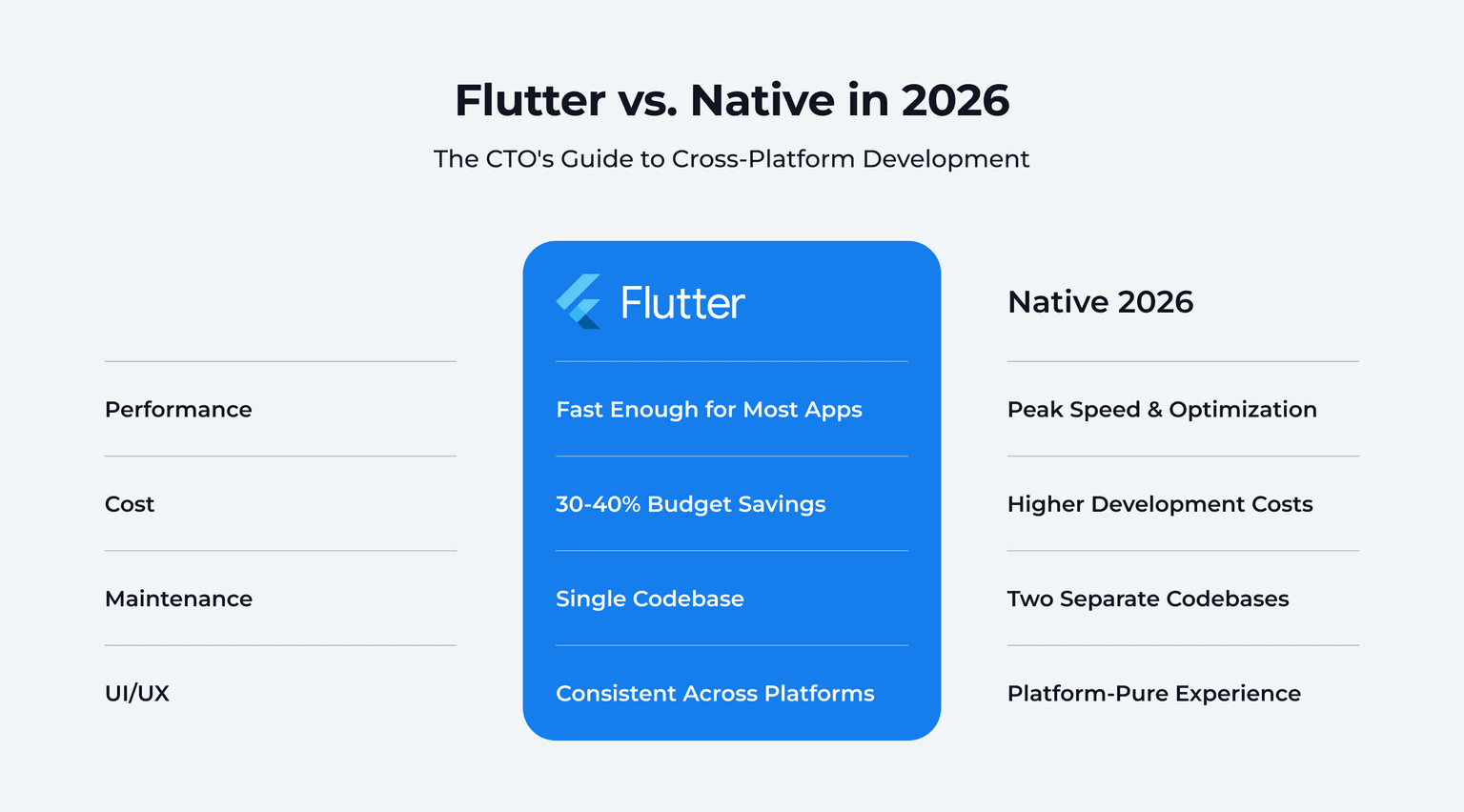
For CTOs, the Flutter vs native decision should be grounded in measurable trade-offs rather than ideological preferences.
Below is a breakdown of the most critical dimensions.
Performance: Does Native Still Win?
Native mobile apps still achieve 5–10% higher peak performance in CPU- or GPU-intensive scenarios. However, in typical ecommerce, fintech, healthcare, or enterprise apps, this difference is rarely noticeable to end users.
Key question for decision-makers: Will the user perceive the performance gap, or will it only matter in benchmarks?
In most business contexts, Flutter’s performance is more than sufficient.
Cost: Where Cross-Platform Delivers Clear Wins
This is where the benefits of cross-platform development are most pronounced.
One development team instead of two;
Shared QA and release processes;
Lower onboarding and maintenance cost.
In practice, cross-platform development saves 30–40% of the total budget compared to native development, especially over a multi-year product lifecycle.
Maintenance: One Codebase vs Two
Maintenance is often underestimated during the initial architecture decision.
With native development:
Separate bug fixes;
Parallel feature development;
Higher regression testing overhead.
With Flutter:
Single codebase;
Unified updates;
Faster rollout of fixes and enhancements.
From a Total Cost of Ownership (TCO) perspective, cross-platform mobile development offers a structural advantage.
UI/UX: Consistency vs Platform Purism
Flutter’s rendering model allows teams to design pixel-perfect interfaces that behave consistently across devices and OS versions.
Native UI still offers platform-pure experiences, but this advantage matters less for products where brand consistency and predictable UX outweigh subtle OS-specific nuances.
For most consumer and B2B applications, Flutter strikes a pragmatic balance between consistency and user expectations.
Choosing the Right Cross-Platform App Development Framework
Choosing the right cross-platform solution in 2026 is no longer about ideology (“native is purer” vs “cross-platform is cheaper”). It is a strategic architecture decision that directly affects time-to-market, development cost, and long-term maintainability.
To choose the right cross-platform app development framework, CTOs should evaluate several core criteria.
Project Complexity and Product Scope
Not all mobile products have the same technical requirements.
Cross-platform frameworks are a strong fit for:
Business and consumer mobile apps;
Marketplaces, SaaS products, and internal enterprise tools;
Products with frequent UI updates and iterative roadmaps.
Native development still makes sense for:
High-performance 3D applications;
Deep hardware-level integrations;
Extremely latency-sensitive use cases.
For most commercial products, Flutter covers functional and performance requirements without architectural compromise.
Time-to-Market and Roadmap Flexibility
Speed remains a critical competitive factor.
With cross-platform mobile development:
MVPs reach the market faster;
Feature parity across platforms is easier to maintain;
Product teams can validate hypotheses without duplicating work.
This is particularly important for startups and innovation-focused teams operating under uncertainty. Faster delivery enables faster learning.
Developer Availability and Team Structure
In 2026, access to qualified mobile app developers is still uneven.
Native development requires:
iOS engineers (Swift);
Android engineers (Kotlin);
Parallel team coordination.
Cross-platform development allows:
Smaller, more flexible teams;
Easier knowledge sharing;
Reduced dependency on platform-specific specialists.
From a hiring and scaling perspective, this directly reduces operational friction.
Why Flutter Often Wins Over React Native for New Projects
When comparing the best cross-platform app development framework options, Flutter and React Native dominate the discussion.
Flutter frequently has an advantage in greenfield projects due to:
More predictable performance characteristics;
Strongly typed Dart language, reducing runtime errors;
Consistent rendering independent of platform UI changes;
Less reliance on native bridges for core UI logic.
React Native remains a valid option, especially for teams with deep JavaScript expertise. However, Flutter’s architecture tends to scale more predictably for complex mobile applications.
Conclusion
In 2026, the question is no longer whether cross-platform mobile development is “good enough.” For approximately 90% of business applications, it is the most rational architectural choice.
Flutter has matured into a production-grade framework capable of delivering performance, stability, and scalability that meet modern product demands – while significantly reducing cost and complexity compared to native development.
Unsure which path to take?
Schedule a consultation with our architects to define the best stack for your product.
Book a Call



Co-Founder of DBB Software