Developing a Facility Management Mobile App
Learn how DBB Software helped Facilitron, a U.S.-based facility management company, build and optimize an offline-first mobile application for its employees.
Industry
Logistics & Automotive
Service
Mobile App Development
Team
1 Full-Stack Developer, 1 BE Developer, 1 QA, 1 Part-Time Designer, 1 PM
Project State
December 2022 – April 2025
Country

United States

About the Client
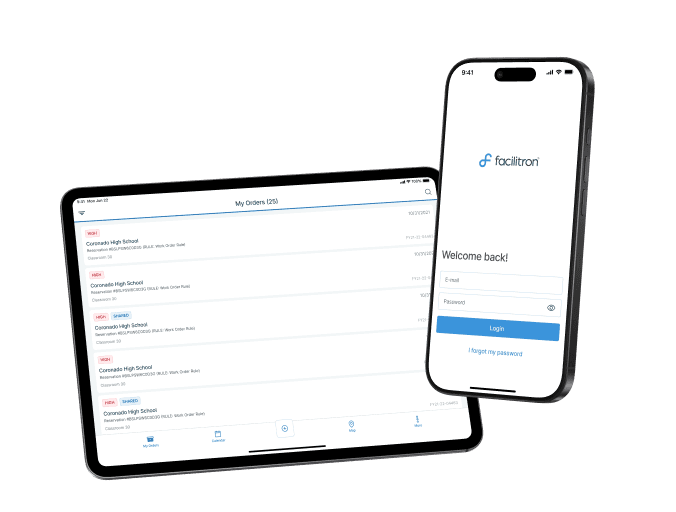
Facilitron offers digital solutions for facility management, enabling organizations to schedule, manage, and optimize their spaces more efficiently. Their platform combines scheduling, operations, and reporting into one solution, serving school districts, cities, and other public institutions.
The Client's Initial Request
Facilitron engaged DBB Software to develop a new mobile application to support its internal teams. Unlike consumer-facing projects, this solution required deep technical ownership from DBBS with minimal client oversight.
Offline-First Experience
The app needed to work seamlessly without a constant internet connection, ensuring uninterrupted access for employees in the field.
01
Full Development Ownership
Beyond coding, DBB Software was responsible for investigating tech stack options, resolving database sync issues, and managing build deployments.
02
Custom Image Handling
Facilitron required advanced image processing capabilities, including style adjustments, auto-corrections, and optimized upload strategies for different connection speeds.
03
Simple Collaboration and Transparency
The client expected minimal management overhead — just two weekly progress meetings — relying on DBB Software to drive decisions and ensure smooth delivery.
04
Solutions We Delivered
DBB Software built the application from scratch and introduced several innovations to meet Facilitron’s requirements.
Offline-First Mobile Application
Developed using React Native and Realm (later migrated to PowerSync), enabling users to work with a local copy of data and reducing unnecessary API calls. Conducted migration POCs with PowerSync and Ditto after Realm deprecation, ensuring long-term stability.
Custom Image Processing
Implemented native modules in Swift (iOS) and Kotlin (Android) for image brightness, contrast, and saturation adjustments. Designed auto-correction features and created caching systems to ensure smooth performance even with large image sets.
Optimized Upload Strategies
Built adaptive upload flows with different strategies for WiFi, 5G, 4G, 3G, and 2G connections. This allowed batch asynchronous uploads on fast networks and synchronous uploads on slower ones, improving reliability in the field.
Testing and Continuous Delivery
Integrated unit tests with Jest, end-to-end tests with Detox, and CI/CD pipelines with CircleCI. Automated deployment processes using Expo, ensuring builds were regularly shipped to App Store and Google Play with minimal manual overhead.
Backend and Security Integrations
Configured custom access rules in MongoDB Atlas, integrated with AWS services (Lambda, EC2, DynamoDB, Cognito), and handled synchronization issues between Realm and MongoDB Atlas.
Results Achieved

Reliable Offline Operations
Delivered an application that worked seamlessly in low-connectivity environments, increasing employee efficiency.

Advanced Image Tools
Enabled employees to process and upload large volumes of images with flexible strategies, even under unstable conditions.

Resilient Architecture
Migrated away from deprecated Realm database with minimal disruption, ensuring long-term maintainability.
Want to Build a Custom Offline-First App?
We help companies empower their employees with robust, reliable, and high-performance mobile solutions.
Contact Us
"Most of our work starts with a 30-minute call where someone describes a product they're trying to ship and one part of the engineering picture they can't get around.
If that's where you are, let's set one up; I'll tell you straight whether we're the right fit.”

Mina Morkos
Business Development Manager


Want a similar outcome for your team?
Ask our AI assistant — it can pull related case studies, talk through the approach, and put you in touch with the team if you want a deeper conversation.