
How To Implement ChatGPT Instant Checkout: A Guide for Merchants
AI
Product development
Updated: May 7, 2026 | Published: November 18, 2025
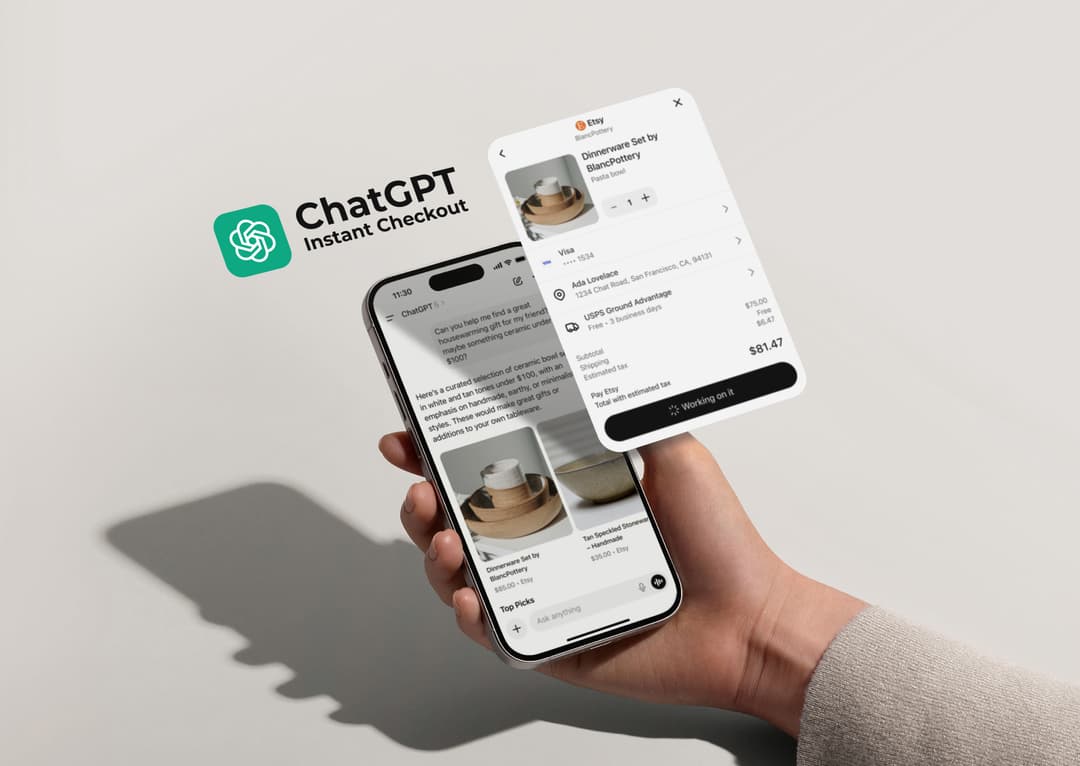
Imagine a customer opening a chat with ChatGPT, asking for a gift idea, and buying the recommended item without ever leaving the conversation. No website. No cart. No checkout flow. Just a simple chat into a recommendation and into a checkout.
You can let users buy directly from your store inside chatbots. With OpenAI’s Instant Checkout, powered by the Agentic Commerce Protocol, merchants can now surface products in ChatGPT search results and let customers complete purchases instantly.
AI shopping is exploding: studies show AI-assisted buying journeys can increase conversions by 25%, while nearly 18% abandon purchases because checkout takes too long. Now, the chatbot checkout has the potential to completely change the flow, simplifying it to a mere chatbot conversation.
This is where the ACP comes in. The ACP gives merchants and developers a simple way to connect existing product feeds, checkout logic, and payment systems via Stripe to the chat interface. For custom platforms, the setup is straightforward: a clean product feed, a checkout API, and delegated payment tokens for going live.
In this article, you’ll learn exactly how Instant Checkout works, how to prepare your store, how to build the required endpoints, and how to avoid the common pitfalls other merchants face. Think of this as your practical roadmap to enable Instant Checkout, boost visibility, and let users genuinely buy directly during a chat.
Why Implement ChatGPT Instant Checkout?
Early conversational commerce tests show conversion lifts of up to 33% because users stay engaged, and the artificial intelligence removes friction from the buying journey. And because OpenAI designed this flow to work seamlessly with the ACP, even custom platforms can plug in and offer a buy directly experience inside AI.
The key benefits of Instant Checkout for e-commerce websites include:
Higher conversions: conversational technology reduces drop-off, helping users buy products instantly.
Frictionless buying: discovery leads to selection and checkout inside the chatbot.
Organic visibility in ChatGPT search results: products appear naturally based on relevance and quality.
Stronger loyalty: customers get real-time order updates and support directly within the conversation.
Merchant control: you remain the merchant of record while OpenAI and Stripe power secure payments.
Benefit | What It Means | Why It Matters |
|---|---|---|
Boosted sales | Up to 33% more conversions via AI-powered commerce | More revenue without paid ads |
Frictionless checkout | Users complete instant checkout in chats | Eliminates drop-off from long checkout flows |
Organic product discovery | Products surface in ChatGPT based on relevance, price, and quality | Free exposure to millions of ChatGPT users |
In-chat loyalty loop | Order updates and support happen directly in chats | Builds trust and supports repeat buying |
By enabling this technology, you’re tapping into a fast-growing AI commerce channel where users can buy products directly within a ChatGPT conversation, powered by secure integrations from OpenAI and Stripe.
What Is ACP and How Does It Work?
To power the feature, OpenAI and Stripe co-developed the Agentic Commerce Protocol (ACP) – an open-source, Apache-licensed standard that lets any merchant connect their store to agents. Think of ACP as the secure “bridge” that lets the chatbot act like a smart shopping assistant: it finds products, builds the cart, and hands it back to your backend to finalize the order.
ACP is already live for U.S. Etsy sellers and is rolling out to over a million Shopify merchants, with custom platforms able to integrate through standard REST APIs. Because it’s open-source, you never get locked in, and you implement once and can distribute anywhere your customers shop.
At a high level, ACP works through three flows: Discovery, Checkout, and Payments.
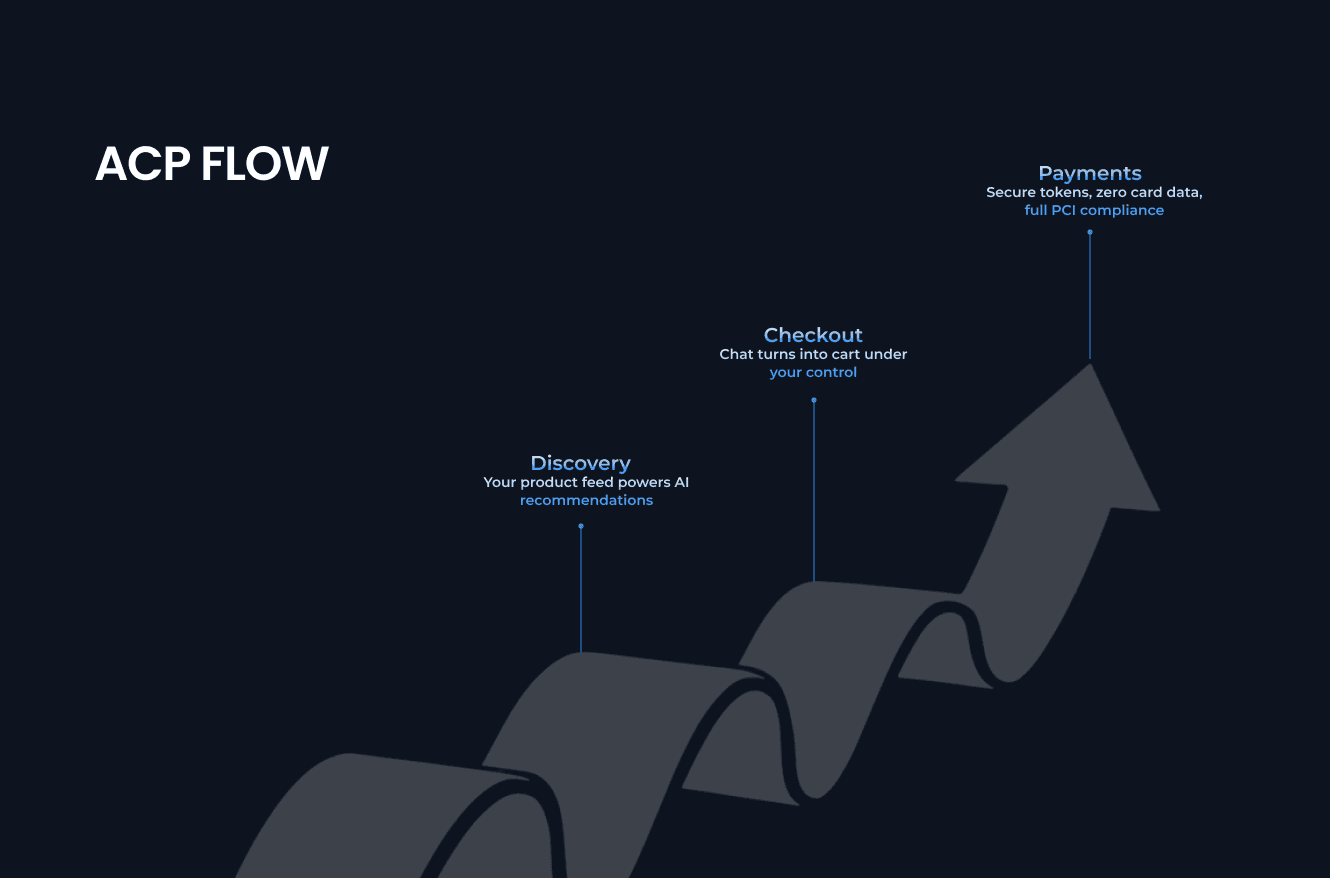
1. Discovery: Your Product Feed for AI
You need to ensure that your marketplace features a structured product feed (CSV, XML, or JSON) containing titles, descriptions, prices, inventory, images, and reviews. The artificial intelligence uses this feed to surface relevant items organically based on user intent.
Here’s why it’s important to ensure discoverability:
Your products can naturally appear in chatbot recommendations.
Real-time updates prevent out-of-stock or inaccurate listings.
Highly structured feeds lead to better visibility and more sales.
2. Checkout: The Conversation Becomes a Cart
When a user initiates a purchase in a chat, ACP triggers the checkout flow. The backend receives item details, buyer info, and fulfillment preferences through standard REST endpoints. You calculate totals, taxes, discounts, and return a final cart for the user to confirm, all inside the chat.
Webhooks handle everything after payment: order creation, shipping, refunds, and cancellations. These updates appear directly in the chatbot, creating a seamless post-purchase loop.
This checkout loop is vital for several reasons:
You keep full control over the purchasing process.
Users get transparent updates inside the chatbot.
Works for physical goods, digital products, subscriptions, and multi-merchant carts that may appear in the future.
3. Payments: Secure, Tokenized, and PSP-Agnostic
ACP uses delegated payment tokens compatible with providers such as Stripe’s Shared Payment Token API. These tokens authorize only the amount and the specific merchant, meaning no sensitive data ever passes through the agent.
Such an approach has several notable benefits:
Full PCI DSS compliance without exposing payment credentials.
Supports cards, Apple Pay, Google Pay, and more.
Built-in fraud signals allow you to accept or decline based on risk.
Open-Source Flexibility & Developer Benefits
Because ACP is Apache 2.0-licensed, merchants and developers get:
No lock-in – works with any backend or payment provider.
Future-proofing – supports upcoming features like dynamic pricing, async buys, and multi-merchant carts.
Community contributions – schemas, examples, and RFCs evolve rapidly.
Lower development effort – “build once, distribute anywhere” reduces fragmentation.
Flow | Key Components | Benefits |
|---|---|---|
Discovery | Product feeds (CSV/JSON), real-time updates | Organic visibility inside ChatGPT |
Checkout | REST APIs, webhooks, cart state responses | Merchant control, seamless confirmations |
Payments | Delegated tokens, fraud signals | PCI compliance, no sensitive data exposure |
Is Your Store Ready for ChatGPT Instant Checkout Implementation?
Before moving forward, it’s important to confirm that your store is actually ready for agentic commerce. OpenAI currently limits Instant Checkout to U.S. merchants, with Etsy already live and the million Shopify merchants rolling out next. Custom platforms can join by integrating with the ACP, giving any merchant the ability to let users buy and complete purchases directly in ChatGPT.
Quick Readiness Checklist
The following list will help you determine how ready you are for agentic commerce.
1. Do You Operate in the U.S.?
The feature is currently U.S.-only for both merchants and chatbot users. If you're outside the U.S., you can prepare and apply, but you can’t fully implement chatbot purchases yet.
2. Is Your Product Data AI-Ready?
A chatbot assistant can only recommend your items if the product feed is clean, complete, and structured correctly. The AI agent relies 100% on your data to decide whether your products appear when users ask their chatbots what to buy.
You need:
Titles & descriptions.
Prices.
Inventory counts.
High-quality images.
Reviews.
Shipping details.
A stronger feed means higher visibility inside chats.
3. Do You Have a Secure Payment Provider?
You’ll need a PSP that supports delegated payment tokens, the mechanism OpenAI and Stripe use for instant checkout. Stripe is the easiest option, with often a one-line update for existing merchants, and supports cards, Apple Pay, and Google Pay.
This enables secure payments without exposing sensitive data to the chatbot.
4. Can You Support API Endpoints and Webhooks?
If you’re not on Etsy or Shopify, you’ll need ACP-compliant API components to enable instant checkout:
REST checkout endpoints (cart creation, updates, totals).
Post-purchase webhooks (order updates, shipping, refunds).
These allow the chatbot to build a cart, confirm pricing, and send real-time order updates inside chats.
5. Have You Reviewed Compliance Basics?
Even with the feature enabled, you remain the merchant of record, meaning you handle:
Taxes.
Shipping.
Refunds.
Fulfillment.
Customer support.
Delegated tokens and fraud signals from Stripe help maintain PCI DSS compliance and keep transactions safe.
How Do You Implement ChatGPT Instant Checkout Step by Step?
The steps below walk you through how to enable Instant Checkout smoothly in your marketplace.
Step-by-Step Implementation Guide
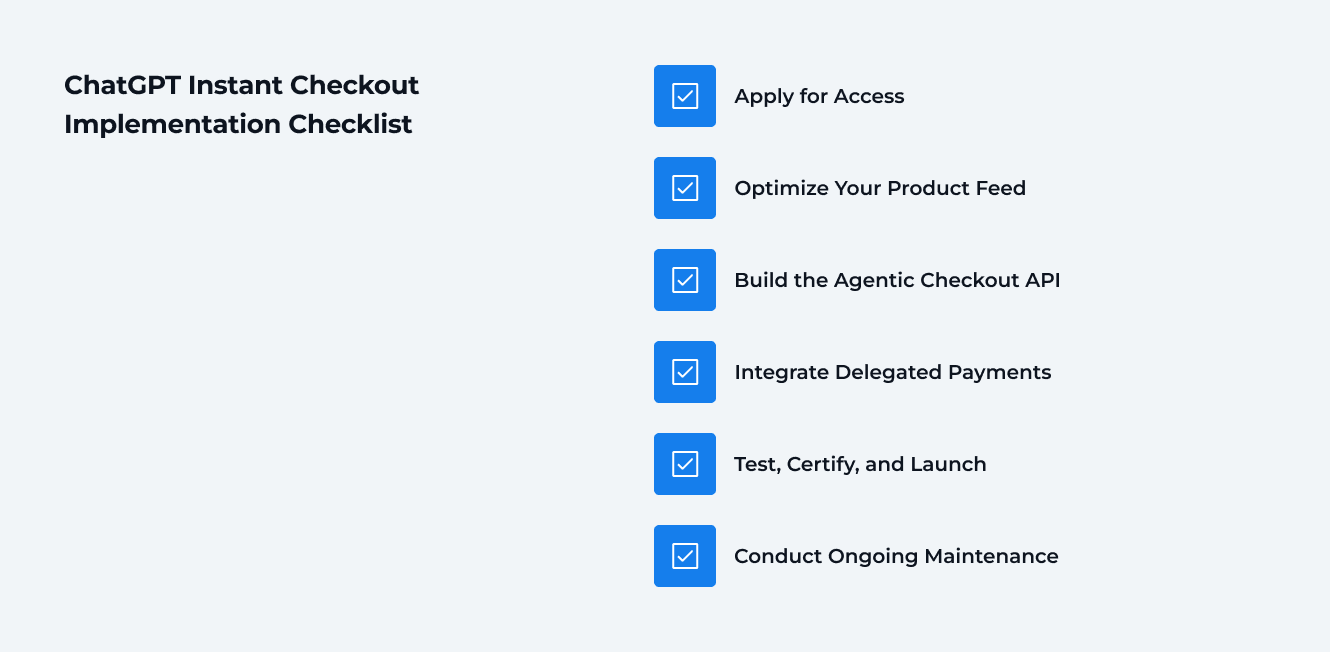
1. Apply for Access
Go to chatgpt.com/merchants and apply to enable Instant Checkout. You’ll list:
Product categories.
Catalog size.
Your planned artificial intelligence integration.
Once approved, you’ll get access to OpenAI’s commerce docs and the official protocol references.
2. Optimize Your Product Feed
Your product feed determines whether the chatbot shows your items in ChatGPT search results. It must follow the Product Feed Spec with:
Titles, descriptions.
Prices, inventory.
Images, reviews.
Shipping details.
Flags like enable_checkout.
To appear when users ask ChatGPT what to buy, enrich your feed with GTINs, taxonomy, and natural-language details.
3. Build the Agentic Checkout API
This is where custom merchants spend most of their effort. You’ll implement the Agentic Commerce Protocol checkout flows so the chatbot can create carts and complete purchases.
Required REST endpoints:
POST /checkouts – create a session.
PATCH /checkouts/{id} – update buyer or item data.
POST /checkouts/{id}/complete – finalize the order.
Your API must:
Validate items and availability.
Apply taxes, shipping, and discounts.
Return a cart state for the user to confirm directly in ChatGPT.
Surface user-facing messages for errors.
Then set up webhooks for order creation, shipping, refunds, and cancellations, so the assistant can deliver real-time updates within the conversation.
4. Integrate Delegated Payments
Payments at checkout are processed via secure, single-use delegated tokens, so payment credentials never touch the chatbot.
If you already use Stripe, enabling delegated tokens is almost effortless (often a one-line update). This supports:
Cards.
Apple Pay.
Google Pay.
If you use another PSP, you can still enable instant checkout via ACP, as long as your provider supports tokenization or PCI-compliant vaulting.
Don’t forget to handle:
Fraud signals.
Tax calculation.
Final payment confirmation.
This ensures a secure, compliant, buy-directly-in-ChatGPT experience.
5. Test, Certify, and Launch
Before orders placed through ChatGPT go live, OpenAI requires protocol conformance checks:
Validate payloads and schemas.
Ensure webhook delivery.
Test error handling.
Confirm API idempotency.
After certification, your products can show up in chatbot recommendations and support Instant Checkout for real shoppers.
6. Ongoing Maintenance
To keep visibility high and prevent disruptions, you want to:
Refresh feeds frequently.
Monitor channel-specific traffic and chat-originated orders.
Track changes to the agentic commerce protocol.
Stay ready for 2026 updates.
ChatGPT Instant Checkout Implementation Challenges and How to Overcome Them
This feature is a major opportunity, but it also introduces new challenges, especially for a merchant navigating AI-powered commerce for the first time. With OpenAI expanding from Etsy to over a million Shopify merchants, expectations are high.
But to successfully enable purchases and let customers buy directly and complete purchases directly in ChatGPT, you’ll need to understand the limitations and risks that early adopters are facing.
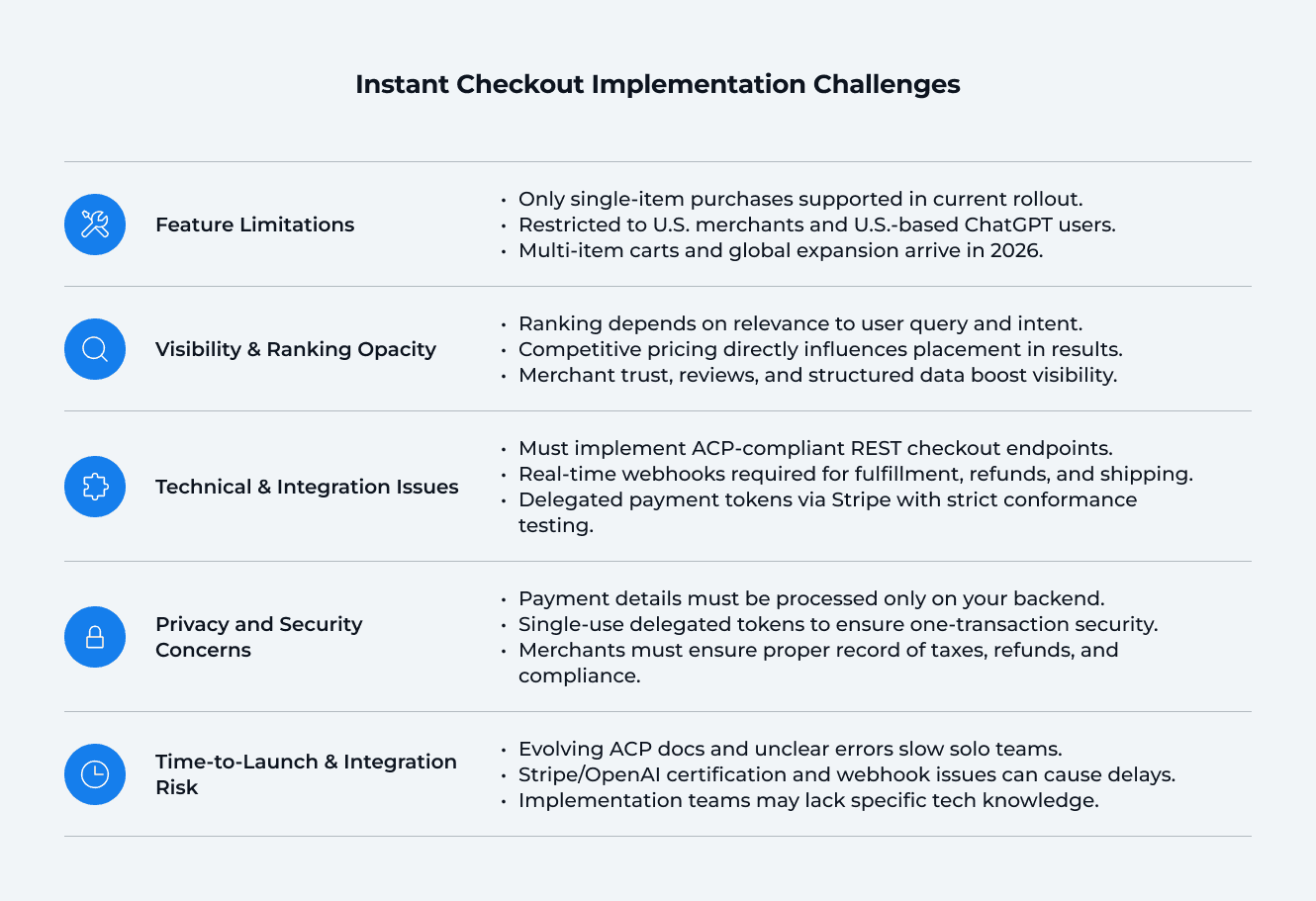
1. Feature Limitations
Because Instant Checkout is still in its early rollout, the biggest constraints today are functional:
Only single-item purchases are supported.
Only U.S. merchants and U.S. ChatGPT users are eligible.
Multi-item carts and global support will not arrive until 2026.
Some Etsy listings with personalization or variant options don’t show the “Buy” button yet.
This means merchants should prioritize simple, high-converting SKUs first. OpenAI has confirmed expanded flows like multi-item carts, global support, and additional PSPs beyond Stripe are coming, but early adopters must design around current constraints.
2. Visibility & Ranking Opacity
Appearing in ChatGPT search results is not guaranteed. The model ranks products organically based on:
Relevance.
Price competitiveness.
Availability.
Quality & merchant trust signals.
Two merchants with similar products may see vastly different placement inside users’ chats. This is a core characteristic of AI commerce, where ranking is contextual and query-dependent.
Merchants should respond by doubling down on structured product data, enriched attributes, and frequent feed updates.
3. Technical & Integration Issues
For custom stores, enabling instant checkout via ChatGPT requires complete adoption of the Agentic Commerce Protocol:
ACP-compliant REST checkout endpoints.
Webhooks for shipping, refunds, and fulfillment events.
Delegated payment token flows via Stripe or another PSP.
OpenAI conformance testing.
Small teams often underestimate the engineering effort. The chatbot may not be able to complete a transaction if a field is missing, the tax computation is incorrect, or the webhook signature is unverified.
4. Privacy and Security Concerns
One of the most pressing questions is “What data does ChatGPT actually see?” Instant Checkout was designed to minimize exposure:
Payment details never touch the chatbot.
Delegated payment tokens restrict usage to a single transaction.
Merchants remain the merchant of record for taxes, refunds, and fulfillment.
Sensitive information stays entirely on your backend.
This architecture ensures secure commerce directly in ChatGPT without shifting liability to the agent. However, it’s too early to see if there are any pitfalls to be aware of, as it’s only being adopted.
5. Time-to-Launch & Integration Risk
Less experienced teams can run into a number of issues and delays with the implementation of ACP and required tweaks due to:
Evolving ACP documentation.
Unclear error messages.
Shifting requirements during Stripe or OpenAI certification.
Webhook reliability issues.
Performance bottlenecks during high-traffic testing.
Because this ecosystem moves quickly, many merchants choose a development partner to handle end-to-end implementation. Partner with an e-commerce-specialized development firm like DBB Software, with 10+ years in software development, AI/ML expertise, and full-cycle service delivery, to receive results faster and safer.
Our list of proven e-commerce projects includes:
Bookis: achieved $4M in GMV, 450,000+ active users, and expanded the platform to Sweden.
Renovai: improved conversion rates by 16%, doubled the time spent on site, and boosted revenue growth by 30%.
Food delivery platform: optimized menu search and ranking features for a more personalized user journey and migrated legacy PHP services to Node.js, improving maintainability.
Prepare for and Implement ChatGPT Instant Checkout with Professionals
Book a call with us to review your eCommerce marketplace and connect it to ChatGPT Commerce.
Book a Call
Conclusion: Future-Proofing Your E-Commerce with AI
Instant Checkout gives merchants a rare chance to meet shoppers in conversation, exactly where their intent begins. By enabling seamless purchases, you shorten the distance between interest and conversion, increase loyalty through in-chat updates, and gain organic visibility in a channel that’s growing faster than any traditional search platform.
And the timing matters. Multi-item carts, international support, and richer agentic experiences are all on the horizon. Brands that move now will be the first to rank, the first to earn trust, and the first to benefit from the compounding advantage of conversational commerce. Waiting means giving your competitors a head start.
If you’re ready to explore how ChatGPT Commerce can fit into your platform, we’d be happy to help. Book a call, and we’ll review your marketplace, outline the integration path, and show you how to get your products discovered and purchased inside chatbots.
FAQ



AI/ML / Back-End / Tech Lead
Most Popular